
Whatever else 9/11 is, it is an extraordinarily personal trauma. It comes to consciousness within its own hall of mirrors, images and thoughts appearing un-summoned and then disappearing before they are neatly understood.
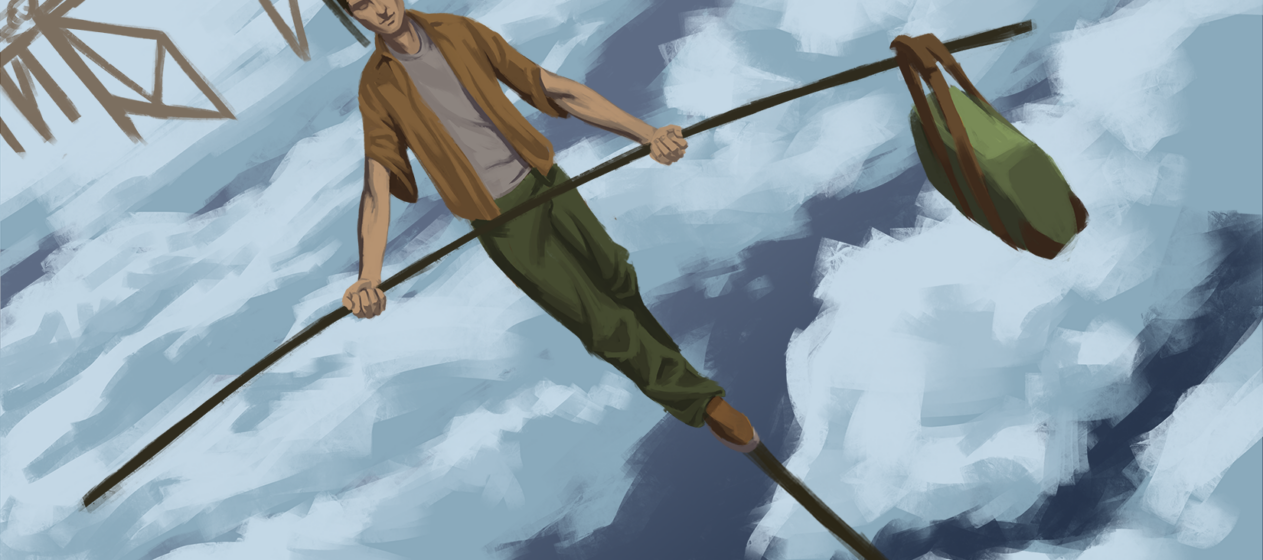
It is the day we fell to earth, and with that thought my mind leaps and I’m in a limo on a New Mexico highway with David Bowie’s alien in Nicolas Roeg’s film, The Man Who Fell to Earth. I glance out the window at a white horse that seems winged as it glides beside our car. Like Bowie’s character, Thomas Jerome Newton, I ride the horse into memory fields as the song from The Fantasticks, “Try to Remember,” whispers like the ghost of irony on the soundtrack.
Try to remember when life was so tender
That no one wept except the willow
Try to remember the time of September
When love was an ember about to billow
Try to remember and if you remember
Then follow, follow.
The Fantasticks? It’s a musical about two fathers who pretend to hate each other to trick their son and daughter into pursuing forbidden love, a conspiracy among modern Capulets and Montagues to marry Juliet and Romeo. Like I said, the thoughts come unbidden. Maybe I’m thinking about the destructive power of manipulation, about the arrogant and terrible fools who toy with the hearts of others out of their own ambitions.
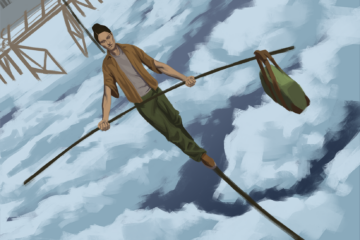
And then there’s another image in the mirrors, Bruegel’s Landscape With the Fall of Icarus, an image that also appears in Roeg’s movie. In the painting, life goes on as a tiny Icarus splashes unnoticed into the sea below. But if I try to draw a parallel between Bruegel’s Icarus and America, the thought falters. Surely we would notice if we fell?
Poet William Carlos Williams wrote about that painting. But it’s another Williams poem, “The Descent,” that offers hope of a way out of the hall of mirrors (pardon auto-formatted line-breaks):
The descent beckons
as the ascent beckoned.
Memory is a kind
of accomplishment,
a sort of renewal
even
Whether we know them as “collateral damage” or “civilian casualties,” slaughtered innocents deserve perpetual mourning from those of us who survive. If we are to find renewal, it will be the accomplishment of such memories, as Williams hints.
We like to think this was something new on our shores, but it was not. If we are to mourn the innocent dead, we have to include the indigenous Americans, don’t we? And many others: slaves, mineworkers, murdered protestors, the wrongfully condemned and on and on. Still, there are the ugly memories of brutal civilian carnage during the 20th Century’s great wars, and 9/11 taught us just how artificial our calendar is. The New Millennium was wishful thinking.
Panic and madness followed 9/11. The towers fell over and over again on our screens. Those in power puffed their chests and promised vengeance. We felt unsafe and uncertain, and power used those frightening images to scare us into giving them permission to war and to diminish fundamental democratic rights in the name of security.
In horrorshow ways, we responded to the falling buildings by jackhammering the foundations of our own social order.
It need not end there, though. Renewal is always possible. Didn’t William Carlos Williams tell us that? The universe is open, after all, and when the Dude abides, that’s what he’s agreed to.
How many millions of words about 9/11 have been uttered? How many experts, commentators, psychologists, and politicians have tried to tell us what that day means? Many today are critical of our repeated return to the events of 9/11. There is concern that it’s driven by commercialized sentimentality and the pursuit of ratings that repeatedly reward the attackers with renewed attention. There’s something to that criticism. And I’m uneasy with the task of explaining its meaning because I do not yet know what it is.
I get help excusing my tentativeness from Cathy Caruth, author of Trauma: Explorations in Memory:
The trauma is the confrontation with an event that, in its unexpectedness or horror, cannot be placed within the schemas of prior knowledge – that cannot, as George Bataille says, become a matter of ‘intelligence’ – and thus continually returns…
It was Ben Saunders’ cool essay on Spider-Man, American pop culture’s longest-lived meditator on the existential anguish caused by our ultimate powerlessness, super-powered or not, that pointed me to Caruth. Spider-Man is forever failing his own sense of justice and fretting over such traumas as the possibility he played an innocent role in the death of the woman he loved (Spider-Man No. 121).
I feel better about my wild and willful, post-9/11 stream of thought. I mean, if Spider-Man can hang with it, I oughta try. He asked, “What good is my fantastic power if I cannot use it?” (Spider-Man No. 1). I suppose the fathers of The Fantasticks asked themselves the same thing.
Another shattered community, the Beatles, came together again in 1995, virtually and long after John Lennon’s murder, to make a song from a tape Lennon had left behind. In “Free As a Bird” the Beatles sing:
Whatever happened to
The life that we once knew
Can we really live without each other
Where did we lose the touch
That seemed to mean so much
It always made me feel so free
Speaking for Icarus, for Spider-Man, for Bowie’s Thomas Jerome Newton, for the Beatles, and for post-9/11 America, an earthbound Lennon asks, “What’s the next best thing to be/free as a bird.”
The next best thing. That seems like an appropriate earthly prayer on this September 11, 2011.


42 Comments


Support this site!
Subscribe to the newsletter
Advertise on Firedoglake
Send
us your tips
Make us your homepage
About Firedoglake
Oh, Glenn, thank you for this reflection.
Two bits from me.
Earlier in the day, our new friend, Om Ali, quoted a line from The Fantastics to me. Oh God, please don’t make me normal. I’m smiling at the syncronicity of two references to that musical on the same day.
Also, I find that when I’m looking at the books at the Thrift Store, trying to decide which one I’m willing to part with 49 cents on, I always look at the publishing page to see if the book was printed before or after 9/11. The implications of that date affect us in a myriad of ways.
As Obi Wan said in Star Wars, I sense a disturbance in the Force.
Gotta love myths. What they explain. What they teach us.
Thanks again, Glenn.
Two mentions of the Fantasticks in one day? That would alarm me, too! :)
A disturbance in the force all right. That’s why I employed some old ripples in pop culture myths rather than a leaner political analysis.
I do that too! Another “meta”-reader, trying to ken the mindset, the place the author is writing from.
Glenn, thanks – somehow this helps. My foolish conceit is put everything in its place in my worldview, and that day has simply never played nice…
Jeez. I’ve read and heard so many words about today. From many points of view and places on the spectrum. These are the best. Now don’t you go thinkin’ you’re special, now, young man— because so many of those words were meaningless, manufactured, tripe. For some, their feelings and rememberances of the event are hard to articulate. For more, it’s just the same old garbage in/garbage out, some of it dressed up and palmed off as profound. Or something. But this is great, Glen. Thanks.
Eggsactically.
It helped me to write it, though it wasn’t easy. Something about the event escapes understanding. It’s like trying to hold water in my hands. Like Emerson said:
He’s not wishing things were less slippery. He’s recognizing the downside of clutching and grasping at ultimately mutable truth.
Hey ya BF. In my head, I sometimes call you Beefheart, ’cause you have a good one.
Yes, Glenn’s take on stuff, worldly and otherwise is a special treat around here.
Thanks Glen, for expressing sentimental thoughts in this cynical world.
Thanks so much, BL. Just seemed that to do otherwise and pin a pretend tale on a pretend donkey and then call it profundity would have been deceitful and not at all reflective of what goes on inside me when I think about this subject.
“The day we fell to earth” – that’s the best description of 9/11 I’ve ever heard. A most humbling experience and with many lessons to teach us if we only listen. I regretfully don’t think we have listened but I mourn for the dead, feel pain for the grief of the ones left behind and honor the men and women who, without thought for their own safety, went in to save as many as possible. The political speeches mean nothing – the mental and physical work that needs to be done is ahead of us.
“I warn you, Icarus, to fly in a middle course, lest, if you go too low, the water may weight your wings; if you go too high, the fire may burn them. Fly between the two.”
Daedalus was right. Icarus should have listened. So should we.
Well said, Twain. The work does remain ahead of us.
Our problem may be that we wove our wings from the fibers of the hubris plant.
Fantastic five minute video for those that still believe the boxcutter mythology. James Corbett knocks it out of the park.
For those of you who are subscribers to FDL like myself, this, evidently, is what the journalists you are paying for believe about what happened on 9/11.
Thanks again, Glenn for a perfect pitch context for today’s observance.
Interesting report on NPR this morning — Paul Simon was originally scheduled to sing Bridge over Troubled Waters at WTC, but instead sang The Sounds of Silence.
Very interesting decision for Simon. Anyone ask him about it?
Good for Simon. I think silence would be a good way to remember that day. Instead it has been turned into a dog and pony show for the politicians to fire up their hate base. I have always liked the Biblical quote “be still, and know that I am God.” Being still is not something that we do well.
I haven’t believed in the notion of order in the universe for decades, and for almost as long, I haven’t believed in the notion of order in human societies either. Events like the murders of John Kennedy, Martin Luther King, and Robert Kennedy, the War in Viet Nam, the Iran Hostage Crisis, the Gulf War, 9/11, the Afghanistan war, the war in Iraq, all seem part of an unknowable landscape, as if we stumble along, then are thrown to some other landscape, equally alien, stumble along, then are thrown….
We are forced to rely on our inner compass, and the inner compasses of others we trust, just to keep moving.
AND THE KILLIN’ GOEZ ON AND ON AND…
Citizen Genn W. Smith:
Bless your heart, Brother Glenn. These last few months my tank of hope and faith in the power of humanity has run close to empty…your Sunday reflections seem to adress exactly what I need and feeds my hungry heart just when I need it.
The gastly trick that the corporate monsters of our midway of terror played on us on that fatefull morning will one day live in infamy for the right reasons…until then we have just our common bond of memory, faith in the strength of life and the power that comes from organizing to hold us together.
Thanks again Citizen Smith…I needed that.
KEEP THE FAITH AND PASS THE AMMUNITION, DON’T CRY: ORGAINZE!!!
I think the whole thing and response says something not always noted about the nature of man that IMO speaks to the claims of the radical individualists.
Yes one small boy dropping into the see from hubris is noted as an interesting anecdote.– even makes one of the myths of our history. But when a large (unspecified) number of our fellow humans are dropped at one time the reaction is immediate, huge and widespread. We see individuals and small groups carryout amazing heroism often risking more for others than they would do for themselves. We see love and compassion all over the place.
One of the guys being interviewed had saved a number of people at the Pentagon by leading them through the smoke filled corridors. He said he didn’t consider himself a hero but his “butt was spring loaded” that day. It got me to thinking, you know when we perceive people are as a group under attack and in danger it seems a lot if not all of us find our butts spring loaded. I think it is a natural hard wired, been there a long time trait that more defines our nature as humans than any lonesome eagle feasting on carrion — or maybe sometimes flying too close to the sun.. That’s my answer to the insane Ron Paul and his ilk.
Not mentioned by Margo Adler who reported from the ceremony in NYC, but did say that everyone who wasn’t overcome with tears, was singing along with Simon. He’s an amazing artist. If you didn’t see the Simon & Garfunkel documentary from 1969 recently rebroadcast on PBS, it’s a post MLK, Jr. & RFK assassinations & pre-Watergate time capsule.
Art says, “Know who else’s birthday is coming up soon?” Paul replies, “Whose?” Art responds, “America’s” After a thoughtful pause, Paul asks, “Think we’ll make it?”
Thanks Glenn for your post. Very thought provoking. I have a personal connection that day. My good friend’s Daughter Nicole was on Flight 93. Our families went on many many camping trips together and watched as she grew into a young lady she was only 22. She and her fiance had been visiting his family in NY and they were both supposed to fly back here the night before but as the plane was full she got bumped only to be on flight 93 the next morning.. I will never forget that day..
Thanks again Glenn and I think you are right we as a Nation fell that day as we very quickly lost many of our constitutional rights all in the name of TERROR. Obviously Bin Laden won that day and we have lost our country. I don’t see us changing anytime soon with all these fear mongers in the government.
Citizen masaccio:
Faith in the right things can be held together by the force of the experience of each other in the struggle, Citizen…that and the understanding that comes from watching the children grow up and the grandchildren showin’ them the way.
With your sensitivity to these circumstances, you are much less likely to get lost. Curiously, I think, we also escape passivity or paralysis when we learn to live with uncertainity. It’s Keats’ negative capability. And he — and you — are right.
Thanks, NF. I needed it too. I suppose I was letting that need talk, and I’m humbled that others are listening to the talking, too.
Change is gonna happen, it’s just a question of what kind of change. That’s our task, one this community takes to heart.
Tis why I keep on coming back to the Lake truly a great resource for oh so many great reasons and your Sunday Posts are a big part of it. Keep us learning Glenn keep on and on spreading your words of wisdom…
TalkingStick, this is in part the subject of Francisco Varela’s profound little book, Ethical Know-How. I think you’d really like it.
http://www.amazon.com/Ethical-Know-How-Cognition-Writing-Science/dp/0804730334/ref=sr_1_1?s=books&ie=UTF8&qid=1315763283&sr=1-1</blockquote
You’re probably right, and it certainly points to a way out of trauma. I have a predilection for such profundities, yet my mind persists in trying. *sigh*
All of this reminds me of Fitzgerald’s closing statement on American progress ….
One fine morning, indeed.
Thank you, Glenn.
The Fantasticks was part of my childhood. My dad played “Try to Remember” on the piano and we would all sing along. The lullaby quality of the song brings me to my emotional knees. My handsome parents, my sweet siblings, my early teenage years rush back at me and I have to duck and weave so as not to falter too badly. It was back when all things seemed possible and suburbia reigned. It was back when we all held that honesty, hard work and forthright behavior won you a place at the table. It was when life seemed easier.
Try to remember.
Thanks Glenn. I will check it out.
I was trying to be a bit therapeutic. We do not suffer alone and we do not heal alone.
Ron Paul is easy to identify but I believe I am seeing among so many, especially younger, people an almost blindness to this communal aspect of human nature. I think it is what makes the right wing Lords of the Flies so successful. Too many of us think they are right and never look for anything different within our own nature.
Whatever you call it this species did not come this far on only competing with each other for resources. The kind of coming together, collaboration and voluntary self sacrifice that we should know so well is not some emotional pity party. It is an essential we hold in common.
I, too, like the “fell to earth” analogy. And I love me some Jerry Orbach.
But, man, I really hated “The Fantasticks.” When I finally saw it, I was shocked that this was the longest-running play in history (at that time. don’t know if still holds that record). Forgettable characters, only one decent song (the one Orbach sings here). Plus, a song about rape? (I think it was called “What a Pretty Rape” or something like that.) I don’t understand what made that play so popular. I was gobsmacked by its awfulness.
Kind of like when I went to see the movie “The Gods Must Be Crazy.” Everyone was recommending it, talking about how great it was, how funny. I did not see why. No, I did not.
Yes, Twain — at it’s heart, Sounds of Silence is a protest song.
And it is the right thing to do. The American populace has been drained of compassion. How do we fix that?
I never really figured out the Fantasticks, either. The rape deal — which the writers tried to explain meant abduction or something — was justifiably very, very controversial and I think to this day various productions delete, change or otherwise reach for something, anything, more humane and ethical and less mysogynistic.
Thanks Mary. I wish I knew or could mobilize the answers. One thing this large event reminds me of how incompetent President Obama is at representing and interpreting the feelings of the people. Leadership by individuals is not enough but it goes a long way. Music as we have spoken of today of course. And I wonder why we have no real music representing these times. The Sound of Silence perhaps.
I found even George W Bush sounding good. at the Pennsylvania memorial yesterday — He actually did and I think has as they do, grown– I recall Reagan at the Challenger and Clinton in Oklahoma City and of course that is what Roosevelt did for years. I think he likely won the 1936 election simply because he spoke of the burden to the human spirit when men cannot find work to earn what is necessary to care for their families. And FDR went out and sent out men and women to find out and report back how the people were making it. And he funded the arts. —
just rambling. — Have a good day.
Not much to add to your reflections, Glenn. Thanks for offering something thought provoking and off beat. Too often we respond to these big symbolic days with ambiguous patterned responses (yes, those again) that claim universal assent (this is how everyone feels). The world is thankfully more complex than that, as are human beings. For all their other problems, stereotypes are just so boring.
Your point about the personal trauma connected with this day reminds me I ought to go back to Susan Faludi’s The Terror Dream.
The parallel between Bruegel’s Icarus and America? Somehow, you know it well:
Daedulus, the clever but vain craftsman, attempts to murder his clever nephew but kills his own son. An apropos fable for the technology-possessed.
Is renewal always possible? Do you suggest we are only sunshine optimists, believing renewal is possible when on the verge of tragedy but losing faith after having fallen in? Renewal is necessary but not “always possible”.
The traumatizing repetition of trauma is the handwork of the terrorist. The visualization of what should have happened could relieve the trauma, but terrorists cannot allow that.
No criticism intended but just an observation. Most of the people commenting today seem to not really grasp the smells and the sweat of being human, but rather speak of songs and fables, intellectualizing staying above the terror and in the doing missing the challenge and the joy of the flesh. Our ideas and ideals are sublime and inspiring but without taste or substance without the raw gut stinking soil we come from and return to. Big trauma forces that connection.
A striking thing that day, after the towers had fallen down and everyone, maybe in the country and beyond, was trying to understand what had just happened, was the silence. On the broadcasts from the sites, in the places where I was and went that day, suddenly, nothing.
Having seen the fall of the buildings, I feared I knew what that silence meant, and though a gratifyingly large number did make it out before too late, it turned out to be so.
People who had gone to work or on business in an ordinary way, now absolutely silent. Those who had gone to help, in many cases because to do so was their business, silent. A person reflecting on all that silence might not wish to see it propogated and inflicted on others, yet there was a clear dread that such is exactly what was soon to happen. Maybe when Paul Simon came near the site, he was reminded.
From another era, WWI, the lyrics to Silencio.
And that’s what’s meant by “the next best thing.”
Thanks, TalkingStick.