

Stephen Soldz has published a devastating critique of the work of the FBI and Criminal Investigative Task Force (CITF) on the controversial interrogation of Guantanamo prisoner 063, the supposed “20th hijacker,” Mohammed al-Qahtani. Entitled “Ethical Interrogation”: The Myth of Michael Gelles and the al-Qahtani Interrogation, the article seriously questions claims that Naval Criminal Investigative Service (NCIS) Chief Psychologist Michael Gelles, and other interrogators associated with FBI, CITF, and other agencies, had fought against the Rumsfeld/SERE-derived coercive interrogation of al-Qahtani, proposing instead a lawful and ethical approach based upon “rapport-building.”
Stephen Soldz is a psychologist, teacher and activist. He is currently the president-elect of Psychologists for Social Responsibility. Dr. Soldz has an excellent blog — Psyche, Science, and Society — which has been covering the torture story, and especially the role of psychologists and the American Psychological Association (APA), for quite some time now.
The current torture narrative, which was retailed in the Senate Armed Services Report on Detainee Abuse (big PDF) earlier this year, is not consistent with what investigators find in the actual alternative CITF/FBI al-Qahtani interrogation protocol, which surfaced last month as part of an ACLU FOIA release. As Soldz describes the situation (bold emphases added):
At the time the plan was written, on November 22, 2002, al-Qahtani had been in isolation for three months and was exhibiting signs of severe mental deterioration to the extent of psychosis. An FBI agent described this deterioration in a report to headquarters….
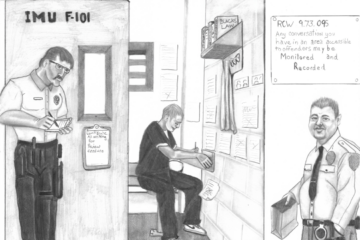
Gelles and the other authors on the CITF/FBI interrogation plan also noticed his psychological distress:“#63′s behavior has changed significantly during his three months of isolation. He spends much of his day covered by a sheet, either crouched in the corner of his cell or hunched on his knees on top of his bed. These behaviors appear to be unrelated to his praying activities. His cell has no exterior windows, and because it is continuously lit, he is prevented from orientating himself as to time of day. Recently, he was observed by a hidden video camera having conversations with non-existent people. During his last interview on 11/17/02, he reported hearing unusual sounds which he believes are evil spirits, including Satan.”
After discussing whether al-Qahtani was faking his symptoms, without coming to a conclusion, the interrogation plan proposed exploiting al-Qahtani’s distress from his prolonged isolation….
In order to exploit this hunger for human contact, the CITF/FBI plan recommended that he be kept in continued isolation for up to an additional year…
Under the plan, al-Qahtani’s deprivation of human contact was something to be exploited. They wanted to make sure the only human being al-Qahtani would see for the next year was his interrogator. This sounds an awful lot like the production of a Stockholm Syndrome in the prisoner.
In the end, the FBI/CITF “rapport” plan was rejected in favor of a continuation of the Rumsfeld-approved SERE-style torture, which only pushed al-Qahtani even further over the edge, and which Guantanamo Convening Authority judge, and Bush-appointee, Susan Crawford in an interview with Bob Woodward clearly labeled as “torture.” But, as we now know, had the FBI and CITF gotten their way, al-Qahtani would still have been psychologically tortured, as the now fully extant “rapport” interrogation plan reveals.
The Compromised Career of Michael Gelles
Michael Gelles is, as Soldz points out in his article, a noted expert in so-called “ethical interrogation.” He was appointed to the APA’s 2005 task force on Psychological Ethics and National Security, and was also a member of the “Experts Committee” for the Intelligence Science Board’s 2006 Educing Information (large PDF) study on interrogation. The Obama administration has relied heavily upon the latter for constructing its own interrogation policy in the aftermath of the Bush/Cheney torture debacle.
Of course, Dr. Gelles is also implicated in the Daniel King scandal of about ten years ago, when he was involved as a NCIS psychologist-interrogator in the abusive treatment of a prisoner, such that the latter was driven to make a suicide attempt, according to one of the defense attorneys who worked with Petty Officer King. I wrote some articles on this not too long ago, and I should note that Dr. Soldz mentions these articles favorably in his piece, as well as indicating that he and I discussed other aspects of Gelles’s career.
In his new article, Dr. Soldz cites an essay by Gelles and a colleague. Written in 2003 — either after the controversy at Guantanamo over the Al-Qahtani interrogation, or contemporaneous with it — “Ethical Concern in Forensic Consultation Regarding National Safety and Security” is representative of the thinking of some mainstream interrogators (like Gelles). Citing the writings of psychologist and legal/ethics professor Thomas Grisso, Gelles and co-author Charles Ewing claim that when it comes to work in national security settings, psychologists, psychiatrists and other mental health professionals cannot be expected to follow the regular ethics of their professions, i.e., “in situations where the ethics of their conduct will be judged, post hoc, either by rules that have little if any relevance to their vital governmental functions or by professional organizations or licensing authorities.” This is convenient if you want to bend, stretch or break the rules — something to which Gelles, the FBI and CITF have been proven susceptible.
But when I contacted Dr. Grisso last summer, he indicated that Gelles and Ewing had not understood his position at all. As Dr. Grisso told me (for attribution):
In my personal view…. [b]arring mental health professionals from sensitive national security employment deprives society of the potential for their services to meet a vital societal need. And exempting them from their professions’ ethical codes when in these particular employment positions is illogical. Mental health professionals in all clinical roles face situations in everyday practice in which they must weigh competing ethical concerns—sometimes involving life or death—on a case-by-case, moment-to-moment basis in order to make principled decisions about their response. They all run the risk that a professional association’s ethics board might someday judge their decision as ethically wrong. If they want to minimize that risk, they can avoid employment in positions in which that risk is heightened. Or they can accept such employment knowing that they may sometimes have to refuse to do what their employers expect of them.
Gelles and Ewing’s misunderstanding of Grisso was not a mistake. Michael Gelles is a major ideologue for a certain kind of abusive interrogation, which while it falls short of the type of torture advocated by the Bush/Cheney administration, nevertheless propagates cruel, inhuman and degrading forms of interrogation, themselves banned by law and international treaty, and often rising to the level of full torture itself. When one of the interrogators gets caught in prisoner abuse — as Gelles was in the King case — the establishment ignores the offender or rallies around him or her to protect them.
Recent events have shown that the torture program has far more extensively corrupted the military, intelligence, and police agencies than was even understood previously. Dr. Soldz has done us a favor and labored mightily to put together all the pieces to show that the fairy tale of whistleblowers at Guantanamo is untenable. The longer we go without some measure of accountability, the more corrupt and desperate the situation becomes. Like an omnipresent toxin, the crime of torture is seeping through the pores of our society, and in the end, no one will be untouched, forced to live in a society with no real rule of law, no profession bound by ethics, the recreation of Hobbes’s bellum omnium contra omnes, the war of all against all.


25 Comments


Support this site!
Subscribe to the newsletter
Advertise on Firedoglake
Send
us your tips
Make us your homepage
About Firedoglake
Continuing to evade responsibility for this horror all but ensures we will reap the whirlwind.
If we had ‘leadership’ we would expect our own Nuremburg Trial with accountability and consequences. But we don’t. And so many in our military-industrial-infortainment-complex have made a fortune as a result. So its all good.
We would have our own cspan Nuremberg Trial channel.
Another terrific report, Jeff. It seems pretty basic to me that the whole concept of rapport building becomes impossible once torture has occurred. At any point after the first instance of torture until release of the prisoner, every action by the detaining authority or its agents becomes just another aspect of the original torture. How on earth do the interrogators think that they can make previous torture disappear from the prisoner’s mind and just move on as if nothing has happened?
Well, some cliche like reap and sow comes to mind.
Great comments, thus far. I LOL at the idea of our own Nuremberg Trial channel… though maybe not that far-out an idea!
Jim is absolutely right, e.g. “It seems pretty basic to me that the whole concept of rapport building becomes impossible once torture has occurred.”
One could extend that: how does a society go back to normal once it has passed the line of civilized behavior into barbarity, with no accountability or transparency about what has happened?
I hope all go and read Dr. Soldz’s full article. It’s very informative and well-written. This piece of mine is an hors d’oeuvre, his article the entree.
This is one of those inherently ambiguous ethical quagmires whereby moral qualms collide with the ex post facto psychological and emotional reality of 9/11. However you feel about torture….about what constitutes torture…you’ll almost certainly never convince most Americans to give a damn about the legal rights of those they are convinced are responsible for it.
And even if you begin to make headway another terrorist attack will flush it all down the toilet.
And from my vantage point the torture not discussed much at all is the torture that still goes on. And that is the horror of being plucked from Afghanistan 8 eight years ago, sent to Guantanamo, denied any legal right to confront either the accusations or the accusers and left to rot…indefinitely?
It has been shown repeatedly that many of the so-called terrorists were really men turned over to the Americans for a cash bounty…or because someone turned them over to settle a personal grudge. They just rot there year in and year out not charged with anything…but not released. A Kafkan nightmare that, were it happen to me, would be tortuous in the extreme.
One would think that enforced isolation for over a year – when the isolation is specifically targeted at the victim’s psychological vulnerabilities – accompanied by diet manipulation, other sensory deprivation and a rigorous program of interrogation would amount to cruel and inhuman treatment. The length of time involved in such a “rapport-building” technique would make most facts the victim knew obsolete. What facts remain relevant would be increasingly hard to select out of a haystack of pathological imaginings.
All that, of course, is endured before the government really knows whether its prisoners is the worst of the worst or a taxi driver caught in the wrong place at the wrong time.
While purporting to be a rapport-building technique, this is still a way to break the victim and remove him permanently from society, indeed, from himself. The “good” side of America’s torture regime seems little different from the dark side.
Great post. Thanks for all the information although it’s hard to read. Hope it’s okay if I quote you.
This is certainly my point, and I believe that of Stephen Soldz as well. I think the Al Qahtani interrogation is only one instance of the FBI putting forth themselves as “good cop” to CIA’s “bad cop”. This is what happened in the Zubaydah interrogation as well, and god knows how many other interrogations over the years.
Did you know that tens of thousands of interrogations have taken place over the years, and that all of these were taped? Another Seton Hall study-PDF
what I find particularly scary about American torture techniques (well, in addition to the fact that there are American torture techniques at all, that is), is that many of them seem unrelenting. This isn’t just the beatings that happen in a police station to force confessions, or a few days or weeks of electroshock torture or stress positions to elicit false confessions for propaganda purposes, or even the withholding of food or sleep or medical care for days or weeks – the normal tools of brutal thugocracies around the world. This is subjecting people to month after month or year after year of treatment specifically designed to grind down POWs and ultimately make them go insane. It’s tortured turned into a chronic condition. And in a way it’s even more horrifying than pulling out fingernails or waterboarding somebody. Torture of this prolonged/permanent nature is associated in my mind princially with mid 20th century totalitarian regimes. Since when do we take our cues from Uncle Joe Stalin?
I wish I could have advised the prisoner. I would advise that it is better that he kill his minders (or as many as he could take with him) before he was himself taken out.
Torturers deserve the death penalty, whether by the judicial system or from their victim(s).
actually.. now that I think about it I guess we did take our cues from such regimes. Weren’tmany of the SERE techniques adapted for use by shrubo’s CIA based on things the Chinese and North Koreans did to our POWs during the Korean War, and, heck, they probably got some of those techniques fro. the Russians?
I hope it’s not hard to read because the writing is that bad ;-)
I assume everybody knows any fair quote or pick up of text if fine by me.
To Blub @10, yes, it is redolent of totalitarianism, and quite frightening. I suppose to Jose Padilla or Binyam Mohamed or the thousands picked up and routinely held and tortured or abused by the military, to the hundreds of thousands that crouched in terror at U.S. bombs, that the U.S. might already look quite totalitarian to them.
Whenever the U.S. elite speaks of “freedom”, they mean the freedom for them to make money. That’s all that it amounts to.
And national security means, the security that their freedom to make money won’t be disturbed.
Thanks very much for this. There are those who don’t believe this but torture is one of those ultimate corruptors. Unless and until it is rooted out, it will continue to kill what’s good in our society. I never really believed in the sanctity of the FBI interrogators, even if only because they do “backfilling” on prisoners previously broken by other agencies. But they, themselves, have never divorced themselves from the “third degree”, which was the root of sleep deprivation and noise sensory deprivation in the 20th century.
And they have no problem, as seen in the Aafia Siddiqui case, with “building rapport” with someone who has just come out of surgery for two bullet wounds that nearly killed her, and is strapped to a four point restraint bed under 24/7 lights and cameras, and has no idea what has been done with her child, and is being interrogated by one of those involved in shooting her, for two weeks straight followed by a rendition without extradition or consular access to New York and strip and cavity searches and total isolation for months courtesy of the federal B.O.P. Two months of hypnagogic visions of her children ended when she found out her eldest was safe and she had human contact, and that means she was malingering because nobody has hallucinations that ever go away without meds.
I guess they also had no problem with harassing Bruce Ivins to death, either. Nice bunch of people. Only a society halfway into the tank on torture could have held them up as good guys because someone else it was employing was worse.
Jeff,
Thanks for your continuing work on this subject, and for this important diary.
One minor quibble, possibly a typo: You wrote,
(emphasis added)
I think perhaps you mean “related”, meaning discussed or described? Although perhaps at one time Mitchell and Jessen (sp?) might have thought of a way to retail it… (*g*)
Bob in AZ
Thanks for bringing up the Siddiqui case, one which I keep wanting to write about substantively, but I think back away as I don’t want to enter that world of terror. I’m particularly susceptible to that (made so, I believe, by already working with torture victims). But her case is so compelling….
The modern drive to outlaw torture as a crime against humanity started when Voltaire woke up one day, read about the Jean Calas case, and realized his self-satisfied life as a satirist of society and a philosophe was a lie, if torture persisted in society like that. He started a campaign the rest of the Enlightenment elite would pick up. That’s why Washington and the rest were so sensitive on the torture question during the American Revolution… they were steeped in Voltaire’s writings on tolerance, on D’Alambert, Rousseau, etc.
But we are so far from that now. Brutalized by the immersion in “total war” over sixty years ago, and outrageous power sealed in via nuclear fusion, what began as a paranoid program in mind control by the military and CIA in the 1950s and 1960s, has blossomed into a cultural virus run amuck.
And Bob in AZ (@15), I did mean “retailed”, which does have the meaning also of told or retold (see Webster), and I used precisely for the double meaning implied, which you picked up on, i.e., that this story was sold to us as the truth (but it wasn’t, or at least not the entire truth).
“Retailed” indeed, Jeff. Thank you, and Stephen, for alerting us to this contradiction between the FBI’s words and deeds.
Jeff made an important and significant choice of words, Bob @ 15, given the almost entirely-private testimony and staff research that generated Carl Levin’s Senate Armed Services Committee report on detainee abuse (that focused on the Department of Defense and excluded the CIA).
Surprise, surprise, that non-public testimony, for a quietly-released report that trustingly relied on the Bush Executive Branch of government to be fully forthcoming with information requests absent subpoenas or public confrontation, and which has had zero follow-up, is flat wrong about a grave matter of FBI/DOD abuse of power utilized to inflict pain and suffering on a helpless detainee.
I’ve mentioned before that Carl Levin waited until the last day the Senate was in session in 2008 to release the unclassified version of his report. Months later, the full report Jeff references quietly emerged, to effectively no notice (Levin showed up on Maddow for one interview, urging Obama to appoint some retired judges to review the matter), and then the report and its (it turns out, in at least one instance) convenient cover story soundlessly sank beneath the waves.
Once more, we are completely indebted to the ACLU (which just lost 20% of its annual funding because of the financial troubles of one of its most generous donors) for this knowledge, and for doing on its own time and with its own money the work that Congress is designed for, and Members of Congress swear an oath to undertake, only to shirk it at every opportunity by turning their backs, blocking their ears, and covering their eyes.
Disturbing but important post. As a newly minted Bush-Obama-era activist, I’m trying to stay on top of two issues, torture and illegal wiretapping. But it’s so spiritually oppressive to see what my country in turning into, and even the time investment is hard.
I apologize for griping, but for some reason I’m reminded of Oscar Wilde’s quote to the effect that “Socialism requires too many evenings,” i.e., you have to go too many meetings. Whoever thought the same would be true of Constitutional democracy in the United States of America?
Anyway, I’m starting to read Karen Greenberg’s book, “The Torture Debate in America.” I’m embarrassed to admit I hadn’t heard your name before, Mr. Kaye, but you’re on my radar screen now (in a good way).
And the ‘freedom’ to rape people for political reasons.
I was illegally wire tapped.
My brother in law, Jery Stedinger, is a professor at Cornell University in New York. He did it, I saw him him do it. He might claim I gave him permission or that he didn’t do it. I doubt he will admit it because to admit it, would be one of those things not allowed under the cover up phase “national security.”
He got a big prize from the Saudi royal family equal to a year’s salary that he claimed he didn’t know what it was for. Then, he put a Saudi checkered scarf thing on his head and asked permission to use my computer, an old thing he never showed any interest in before as he has dozens of his own. I said OK.
He installed some spyware into my computer.
I know it was there because it created new and suspicious wavy patterns on the screen like it was reading the page. It came and went based on what I was doing, so in a little while I figured out what it was interested in – my activities to end the drug war.
I wondered why the Saudis would care and why they were the agents to pay off my BIL, a big time Boy Scout, to violate my constitutional rights.
I tried to alert the press about it but they would have none of it.
When I tried to tell my husband about it (he was a reporter for the local paper when we first married 30 years ago), he became angry and violent in his denials. When I called an old friend of his working for the big San Francisco newspaper, his wife told me that they couldn’t help me and to stop calling them. He was the best man at my wedding and a working reporter in a big city.
When I was the victim of illegal spying, NO ONE would do anything but reject me and my story – COMPLETELY.
It was an absolute wall of rejection. After that I took a class at the local JC to work in their paper.
In class I decided the whole lot of them are CIA agents. It was/is very frightening, especially when I think about my children. From what I have seen of the CIA, they especially LIKE to torture people. They also have sex with children just to fuck up their heads and turn them into prostitutes. It is their ‘culture’.
I am afraid my children are victims of this culture of corruption too, just like I am afraid my husband and his reporter friends in high school were victims of it. My husband had such a strong conviction that my efforts were all useless, that he put a HUGE amount of effort into proving it and he eventually tore me apart.
It is really scary to think the CIA is actually in charge of everything, even to the point of getting your own husband to torture you. I couldn’t believe it was happening to me, but it was. It did.
I blogged the whole damn thing in AlterNet.
Thanks for the excellent ongoing coverage of this issue. The immorality of it is obvious enough to make me so mad that I feel ill. But what I find interesting is the practicalities–or lack thereof.
Torture–especially the kind you describe–becomes self-perpetuating by being completely ineffective. We create delusional states in people that might or might not have information that we want. The delusional state makes it impossible to trust what they tell us, even if it stays consistent and plausible. So we need to apply more pressure to extract more, which is less reliable still. When we try to confirm or act on what we’ve extracted, we can’t. So, again, more torture. An industry is born.
In a small way, I know that real rapport-based interrogation works because I used it in a past career as a teacher. I had good success extracting confessions of cheating from people that knew that they could lose scholarships, expose fellow fraternity/sorority members, and be expelled if they confessed. I never made threats. I never even raised the subject of cheating until the very end. I’d just ask the suspect to come into the office for a chat about his paper or test, as I would do normally. I’d ask them to explain this or that passage in more detail, ask how they reached conclusions, etc. Eventually, the strain of trying to carry on a normal conversation while lying became too much for them. Always. The clear-and-present social discomfort was worse than potentially worse consequences that were more remote.
I stumbled on this technique because I found the situation so embarassing and distasteful myself. I just didn’t want to get to the point. But, in retrospect, I realized that the only practical counter to this kind of rambling, indirect interrogation is resolute silence–and that, for most people, that is harder than confessing. Put two people together and you have a conversation, willing or not.
Somehow we have let ourselves be brainwashed into thinking that the familiar social and moral rules that get us through daily life aren’t enough after 9/11. Why aren’t they? Instructors have been stabbed in their offices by students. Motorists are shot by other drives. Husbands are stabbed by wives and vice versa. All are every bit as dead as anyone killed by a self-proclaimed jihadist. So why can’t the same laws and social norms that have prevented and/or handled day-to-day mayhem for centuries, in both peace and war, handle pos-9/11 criminals and malcontents? Why are we glamorizing the latter with special treatment?
The answer is, I think, that extraordinary treatment makes the ordinary problem extraordinary, justifying more treatment. Again, ineffectiveness is self-reinforcing and self-justifying.
Excellent post, both for its logic and humanity.
I just read the piece on P.O. King and NCIS. I know people who served in the Navy and recount multiple, less drastic attempts by this unit to manufacture realities that can be punished while, often, protecting senior officers from the consequences of dereliction of duty.
One incident at least was well publicized: http://en.wikipedia.org/wiki/USS_Iowa_turret_explosion. Remember the bizarre, homo sexual love triangle/mass-murder-suicide plot that NCIS cooked up to explain the turret explosion? When the reality was that the propellant charges for the guns were very old, had been improperly stored, and were being loaded at an unsafe rate?
It’s time to start speaking truth to power: if Osame bin Laden got away, he got away BECAUSE of so-called intelligence-gathering practices that manufacture stories that politicians can use instead of discovering facts that serve the cause of justice. And if we have another mass-murder like the one in New York, it will likewise be because we preferred fiction to fact and NCIS/SERE/Gitmo to investigation and trial.
Thank you. I don’t get accused of both at the same time all that often.
Appreciate your comments, which I certainly identify with. I’m particularly glad you reminded us of the Iowa Turret Explosion investigation. The Navy really set up a disaster. The crew knew something terrible would happen. And then when it did, the Navy set up a crewman as the scapegoat/criminal. I, too, know of other NCIS cooked “investigations”.
I’m still waiting for the main print press to notice the Seton Hall report. Good for Olbermann, but where’s everyone else? NYT, Washington Post, LA Times, even the Miami Herald…. WTF?