

In part one of this article, we looked at why the psychological report on Abu Zubaydah was ever written, and concluded, "It is clear the evaluation was written specifically to get permission for waterboarding, and not to undertake a serious psychological evaluation of the prisoner." In this second part, we look at when the report was likely written, and why the timing of it was consistent with the claim that the "evaluation" was really a pro forma performance for the sake of the lawyers. In addition, we will examine how some of the bogus claims about Zubaydah are linked to the cover story that brought about the torture program itself.
When Was the Evaluation Written?
The report was almost certainly written in July 2002, not long before it was passed to the Office of Legal Counsel (OLC). It likely was part of a packet of material used to present the "Enhanced Interrogation Techniques," including waterboarding, as potentially "safe" to use.
There are plenty of indications in the report that Zubaydah had been under observation and interrogated (tortured) for some time prior to the drafting of the report (emphasis added).
Of particular note has been subject’s ability to manage his mood and emotions during detention. [About four lines redacted] In addition, he showed strong signs of sympathetic nervous system arousal (possibly fear) when he experienced the initial "confrontational" dislocation of expectation during an interrogation session…. As has been observed during his recent detention, he was able to quickly bounce back from these most disconcerting moments and regain an air of calm confidence, and strong resolve in not parting with any other threat information.
By sympathetic nervous system arousal, the report’s author means rapid breathing and heartbeat, dilated pupils, raised blood pressure, a spike in adrenaline, muscle tension, increased sweating — noting "fear," possibly Zubaydah experienced a panic attack.
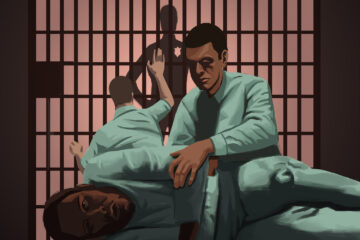
What could have brought about this "’confrontational’ dislocation"? Most likely it was the appearance of James Mitchell and his SERE-style torture methods, replacing the early "rapport"-based interrogation of Ali Soufan and the FBI interrogation team. What Mitchell or whomever is saying here is that when things got rough, Zubaydah was temporarily shaken and "talked" more, subsequently regaining his "calm" and not producing more of what the torturers wanted.
Mitchell arrived in Thailand sometime in April 2002, and FBI interrogator Ali Soufan left in mid-May, in protest over the implementation of Mitchell’s "learned helplessness" techniques. Already, Zubaydah had been subjected to forced nudity, sensory overload, shackling and sleep deprivation (and I’d guess, dietary manipulation, i.e., slow starvation), and perhaps other cruel treatment. (Soufan admitted that the FBI interrogation did not meet Geneva Common Article Three standards, either.) If my thesis is correct, the "dislocation" took place sometime before mid-May.
This appears to be corroborated by the fact that it was in mid-May, according to a narrative released by the Senate Intelligence Committee (H/T again to Marcy Wheeler) that the CIA first proposed ratcheting up the pressure on Zubaydah, including the use of the waterboard.
According to CIA records, because the CIA believed that Abu Zubaydah was withholding imminent threat information during the initial interrogation sessions, attorneys from the CIA’s Office of General Counsel met with the Attorney General, the National Security Adviser, the Deputy National Security Adviser, the Legal Adviser to the National Security Council, and the Counsel to the President in mid-May 2002 to discuss the possible use of alternative interrogation methods that differed from the traditional methods used by the U.S. military and intelligence community. At this meeting, the CIA proposed particular alternative interrogation methods, including waterboarding.
The frustration with Zubaydah — who by mid-May had recovered from his "dislocation" experience (or conversely, had simply nothing more to say, or was already beyond reasonable functioning) — places the portion of the psych evaluation narrative on this point a minimum of two months before the report was presumably written.
It also means the report could not have been written before mid-May. If the psychological evaluation was written to assess Abu Zubaydah’s ability to handle interrogation, or to assess what types of interrogation techniques might be most effective, then it would have been written much earlier. It looks as if they were interested in running an experiment, trying out certain (SERE) techniques, irregardless of the actual psychological characteristics of the individual involved. That’s why there was no earlier evaluation. The only purpose for this evaluation was CIA concern that they would not be caught doing something "illegal," i.e., to cover their asses.
Abu Zubaydah and the Al Qaeda Resistance Manual
The contradictions regarding the portrayal of Abu Zubaydah’s life, noted in part one of this article, are most pronounced around his relationship to the vaunted "resistance" techniques of Al Qaeda fighters. The report retails alleged claims that Zubaydah actually wrote the manual. At another point, it states he is "familiar and probably well versed" in Al Qaeda resistance techniques (emphasis added). It’s easy to forget today that Zubaydah was later proven to never have been an Al Qaeda or Taliban member, nor "privy to the information the government alleged he had provided" (H/T Gitcheegumee).
As Marcy Wheeler has pointed out, the claims regarding Abu Zubaydah and the Al Qaeda manual coincide with the early stages of the torture program, when a Mitchell and Jessen review of said manual was used as a cover for the experiment of reverse-engineering SERE techniques into a physical torture program to use on supposed Al Qaeda prisoners.
As a recent article of mine pointed out, the ostensible Al Qaeda manual likely was part of a cover story originating with CIA/Special Operations officers, operating on orders from Cheney’s office, and sent down through the JPRA command, who used Mitchell and Jessen, and possibly other outsourcing companies, for implementation of a new torture program. It didn’t hurt that they all planned to make a lot of money in the process.
Once the torture program was well under way, the Al Qaeda manual meme faded away, and JPRA insinuated itself as the new, go-to agency for "war on terror" interrogators. In the end, a turf war ensued, with JPRA, Special Operations command, DIA and super-secret covert action arm, the Strategic Support Branch, on one side, and FBI, other existing intelligence groups (like the Naval Criminal Investigative Service) and, to a certain extent CIA, on the other. None of these groups really opposed all abusive interrogations (even the FBI had dirty hands), but were quick to criticize the ineffectiveness of the other group’s protocols.
The conflict still continues today. The latest plan of the Obama administration, introduced by its Interrogation Task Force just last Monday, to create an omnibus group of interrogation professionals and place its center at the FBI, represents a partial defeat of sorts for those who placed their bets on the "learned helplessness" paradigm. But it does not represent the end of torture, only the return to the CIA-oriented program based on isolation, sensory deprivation/overload, sleep deprivation, and fear. The latter are enshrined in Appendix M of Army Field Manual 2-22.3, the new "golden standard" for U.S. interrogations.
Did Abu Zubaydah write the Al Qaeda resistance manual or not? Almost certainly not, but the report’s own contradictions on this point are telling, as it points to carelessness in writing the report, as the product itself was not important, only its conclusion: Zubaydah should be waterboarded. The purpose of the report was to provide a guarantee — because a psychological professional signed off on it! — that it is "safe".
This so-called “evaluation” is obscene, unprofessional, and I’m ashamed that my profession, which has helped so many people, has been dragged into the worst sort of crimes and unethical, illegal behavior. I support the call of Physicians for Human Rights for Congress and the White House to convene a non-partisan commission to investigate the role of medical and psychological professionals in "the design, justification, supervision, and use" of the torture program, and to prosecute those involved.


18 Comments


Support this site!
Subscribe to the newsletter
Advertise on Firedoglake
Send
us your tips
Make us your homepage
About Firedoglake
this absolutely needs investigating. thank you jeff for these difficult posts
Thanks, Suzanne. When I think of the vast evil enterprise that was (and is) the U.S. torture program — CIA black site prisons, rendition, SERE psychologists (and offsite academic consultants), Special Ops Special Mission Units, military prisons, governmental legal departments, various Pentagon command centers, the SecDef office, OVP, contractors, etc. — writing about the subject reminds me of the old parable of the blind men and the elephant: each one sees one aspect and finds it the most important. The compartmentalization of the program only contributes to this difficulty, which is, to wit, apprehending the whole.
That’s why we need an investigation that encompasses the entire thing. Even a prosecution of some of the higher ups (listen to me! how starry-eyed am I?), not to mention the lowly minions, will not fully give us the complete story of how many were involved, how deep into a number of U.S. institutions the rot has spread.
I’m surprised they bothered with such elaborate schemes, instead of just doing the torture and not keeping any records. Records end up condemning you, no matter how clever you thought you were being. I’m surprised they were too dumb to know that.
(my bold)
Jeff,
Thanks for this post and series. In terms of your profession’s guidelines and professional standards, how can this be called a psychological evaluation report? Just giving the submission the title of “psychological evaluation” seems malpractice considering the motives and outcomes?
But those that wanted the “sign off” forget that just because a professional signed off does not make it non-criminal. Professionals commit crimes too. And “they” knew it.
Like a doc supporting an illegal drug habit “legally,” through his “profession.”
Agreed. This is a “psychological evaluation” in only a twisted, CIA sense.
Since writing this, I read Yoo’s July 14, 2002 letter to John Rizzo, “about what is necessary to establish the crime of torture.” Yoo blathers on re this insistence that the crime carry the “specific intent” to induce severe physical pain/suffering or prolonged mental harm. One way, Yoo says, that such intent can be reasonably rejected is… well, read what it says here (emphases added):
One such “effort” was the “psychological evaluation,” which supposedly would show that the superman terrorist Zubaydah could mentally withstand waterboarding. The report was sent to Yoo (probably forwarded by Rizzo) ten days after the above letter. While inferential, I now believe the report was written for this purpose, and between July 14 and July 24, 2002. But remember, the plan to waterboard Zubayda had already been in the works since mid-May. It seems possible to me that some waterboarding had already occurred. Certainly, the other “EIDs”, like being put in a box, had already taken place. Waterboarding was supposed to be the ultimate technique.
It’s hard to believe they really thought AZ had any info to give them. If so, they were deluded. More likely, they were fine-tuning the torture program.
Forgive the OT: Moyers is movie tonight about money machine of medicine, by financial journalist.
Jeff thanks for your notes @ 5
Then “specific intent” be damned Mr. Yoo. It is a crime. An “ex post facto” evaluation is evidence to the crime.
A request for you readers:
A Winnipeg news article today reports that one of the newly released “top secret” CIA memos references former University of Manitoba psychologist John Zubek. Zubek was a key researcher in sensory deprivation, and involved in the development of the KUBARK paradigmatic research associated with MKULTRA, etc. His work was referenced in the scandals around torture of IRA members by the British in the 1970s. Zubek later committed suicide.
I cannot find the Zubek reference in any memo I’ve read, and the Winnipeg memo gives no further link or citation. Has anyone here come across the Zubek reference? It would be very important.
If so, please leave a comment here, or mail me at sfpsych at gmail dot com.
Thanks.
Yes, but we’d have to prove it. But then, that’s what an investigation is for. Hmmm, or videotapes…
“Dislocation of expectation” is an interesting phrase. It’s not commonly found in the literature in the US but is common in British versions of SERE and commando training. It’s used when they put the new set of trainees through a series of unexpected circumstances and seemingly (and really) hopeless tasks. The goal is to not necessarily to evaluate who “succeeds” but who “breaks”…or who rebounds in the next task rather than carry on the trauma emotionally.
That is totally fascinating. I began to google the phrase around, and the first reference was to a Canadian psychiatric use. Except, get this. It’s a reference to a technique to stop violence. Will ironies never end?
[More searching…] Ah, this is the what you are referring to, I believe:
What the AZ case shows is that our government wanted to torture. All the people, agencies, ideas, and actions are bent and twisted to allow this result. Even the ostensible purpose of “gaining actionable intelligence” was subordinated to it. Torture became an end in itself. As Cheney would say, an expression of American will.
As usual, Jeff, your article produces a cascade of thoughts from me. First, the use of a “sympathetic nervous system arousal” as a goal is very worrisome. Small disclosure, I used to have a symptom that a neurologist diagnosed as ‘involuntary panic reaction’: Basically a part of the lower brain dumps epinephrine into your system suddenly, and without warning or psychological trigger, for all the same lack of rhyme or reason that it dumps migraine headaches on some people. And it has another similarity. The way to defeat them was to not let them last long, which is accomplished mostly by knowing what they are and “ignoring” them so they are limited in full effect to a few seconds (not that easy to do, they make you feel like you are dying sometimes). Migraines work the same way, they need to be defeated quickly (with or without intervention). The reason is so they fail to form a habitual pathway, or disrupt one that has formed.
So someone who is deliberately trying to elicit permanent “sympathetic nervous system arousal” is actually going to create brain damage if successful, at the microscopic level by creating pathways for panic attack. That says a lot about the reverse effects that fear tactics have on deprivation. We usually think of it the other way around, both the perps (who characterized the deprivation as “conditioning”) and those critical of the abusive treatment, who often regard the effect that deprivation has on the harsh interrogation tactics as one of it’s evils. Apparently, the fear tactics, the shouting and slapping and nudity, looked at in this light, would have an enhancing effect on deprivation, too. Never thought of it that way.
Second, I have been trying for a little while now to piece together the Aafia Siddiqui interrogations from the ones that are on record, and those were done by the FBI. So thank you for pointing me to your piece about Ali Soufan and the FBI abrogating common Article 3 as well. “Third degree” tactics are no more legal under Geneva or CAT than deprivation tortures, and in fact, modern sleep deprivation derives from them according to Darius Rejali. Tag team interrogations are a form of sleep deprivation just as surely as shackling a person on the ground, prone, with arms and legs off the ground tied to the wall (one wonders why that doesn’t cause positional asphyxiation after a while).
You know, the left is always harping on about torture conducted by the CIA on al Qaeda suspects. However, what I always wondered: If there was allegedly all this evidence that al Qaeda were behind 9/11, why would they need to conduct so much torture? And as of late we’ve been learning just how sickening and savage this brutalization was. I mean, if any of you or I were waterboarded 183 times I’m sure we’d both be “confessing” to 9/11 and all sorts of plots.
It’s now confirmed that that the majority of “evidence and confessions” and findings of the 9/11 commission was based on harsh CIA interrogation(torture) We also know KSM has said he just made up whatever to stop the abuse.
Yet by and large the liberals swallow the official 9/11 meme hook line and sinker just like the “evil right wingers”.
A side note, Gerald Posner wrote a great article regarding Abu Zubaydah, revealing that he told of the identities of at least 8 Pakistani ISI and Saudi GID officials who were helping the 9/11 hijackers…all of whom died of mysterious deaths within a few weeks.
Why doesn’t the left, right or mainstream media talk about the evidence of Saudi or Pakistani ISI involvement in 9/11, or the fact even the FBI maintains that the 9/11 hijackers had quite a lot of help within the US by persons and accomplices unknown?
“The Taliban are not out to take down the U.S. and never were.”
this is a very interesting claim but where is your evidence?
There are also references in Royal Navy training of their Special Forces…at least identifying those who may have the personality profiles. There is also one reference in the Australian Armed forces lit. as well.
Canada, British, UK but no US references…seems a bit odd. Maybe that’s where the Zubek tie is? But Jessen gave a presentation to NATO “Survival, Escape, Recovery, Evacuation” type programs at the HMS Daedelus school back in the ’90’s. Oh…and that citation is found in a Canadians dissertation on the psychology of the survivors of those tortured.
Here’s the link to the Capt. Paul Grimshaw Thesis which cites Jessen’s presentation in l995
Perhaps Grimshaw could be contacted and provide a copy of the conference papers. It might open a door to what Jessen was involved in at the time and what other conferrees were discussing.
Thanks for the link. Since there was plenty of interactions between European SERE programs and U.S. over the years, there were many ways the term could have migrated. Also, we cannot be absolutely sure who wrote the “eval,” or if it was even the work of one person. We just don’t know everyone that was there. Still, Mitchell or Jessen remain the primary suspects. Btw, the JPRA feels competitive and superior to the European programs, but in a stupid way, such that JPRA tops don’t like to hear about any way in which the Europeans might do something better. The spirit of party, so to say, remains very alive in the military.
To ondelette, @13, you were right to point out the stress upon the physiological component, and also how the torture works on a neurological level. All psychological torture is ultimately physical torture, as it acts primarily upon the nervous system, particularly brain subsystems. But the effect is global. Glad to hear you learned to master, as much as one can, those panic storms. — I’m sure Physicians for Human Rights will have a lot more to say about the medical aspects of the torture, as revealed in the IG report.