
Cory Doctorow has a multitude of talents. He's a co-editor of BoingBoing, the fifth most popular blog on the Internet according to Technorati, where he purveys a mixture of technology news, links to strange and wonderful things, and left wing politics. He's been a front line fighter in the wars over intellectual property; he used to be the Electronic Frontier Foundation's Director of European Affairs. And, most importantly for today's discussion, he's a well known science fiction novelist.
Cory has written four novels and multitudes of short stories. Today, we'll be talking about his most recent book, Little Brother. The book is available in yer nearest good bookstore (really - it's a New York Times bestseller so you shouldn't have difficulty in finding it, although you may have to look in the young adults section). Cory also puts his money where his mouth is on intellectual property issues, so if you want to download an electronic copy, it's available for free here under a Creative Commons license.
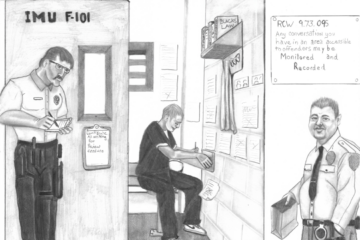
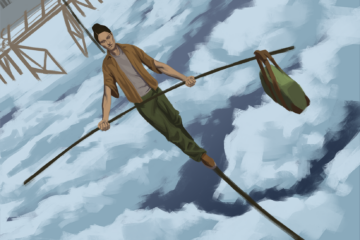
Little Brother is narrated by Marcus, a seventeen year old hacker living in a near-future San Francisco, where the war on terrorism is still going strong, Republicans have won a third term with the help of a Karl Rove clone, and the government has really started to take advantage of new technologies to snoop on citizens. When terrorists blow up the Bay Bridge and the BART tunnel, Marcus and his friends are taken into custody by Homeland Security, because they're in the wrong place at the wrong time. One of them disappears into the system and doesn't come out. Marcus starts thinking about ways to fight back against the surveillance state, using his and his friends' expertise in technology to set up surreptitious communications networks using hacked Xboxes, figure out ways to confuse tracking systems, and organize public events. Eventually, they win a sort-of victory against the powers that be, but the novel makes it clear that this is only one battle in an ongoing struggle.
Before we start talking about the serious stuff, I want to emphasize how much fun Little Brother is. The book's a blast. It's ostensibly written for young adults, whatever exactly that means these days, but is a great read for adult adults too. This is the kind of book you buy a copy of for your brilliant, weird 15 year old niece, and another copy for yourself. Its writing style is clear, punchy and direct - more like the old style early Robert Heinlein juveniles than most of the stuff that's being written today, even if its subject matter is completely up to date.
But in addition to being incredibly entertaining, it's also a very political book. Not only does it have a clear political message (on which more below), but it's full of cunningly disguised how-to lessons for how to baffle the surveillance minions and copyright police. Someone reading this will figure out how to use onion routing to disguise browsing patterns, remove distinctive patterns of noise from your photos, deal with the police if you're stopped and a multitude of other useful life lessons. The book is supplemented by a bunch of instructables that help flesh out the suggestions in concrete ways. Abbie Hoffman eat your heart out.
Little Brother's broad political message is one that most netroots blog readers will agree with - that what Jack Balkin calls the National Surveillance State is a bad and dangerous thing. But what is less obvious are the connections that the novel draws between a host of petty public and private forms of surveillance, and the kinds of really nasty things that governments can get up to when they have too much information about their citizens. When leftwingers think about surveillance, they usually think about things like FISA, National Security Letters, illegal wiretapping and so on. But as Little Brother makes clear, many private companies and organizations are using new technologies to gather information on their customers. This dramatically enhances the power of government to snoop on citizens - it can order these companies to hand over their data (or sometimes not even order them; they often get cooperation without warrants).
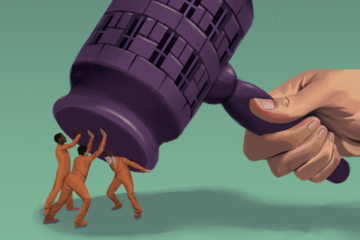
This is one of the main themes (perhaps the main theme that brings together Cory's identities as author, IP policy specialist and blogger - the idea that state surveillance and private means of control (especially those connected to intellectual property) are attacking individual liberty in a kind of pincer movement. Little Brother is a great read - but it also is a great political tract in disguise. It draws the connection between the everyday hassles and problems that teenagers encounter with companies trying to sue them for filesharing, and the much broader set of political struggles over individual freedom in a world of ubiquitous monitoring.
Login Here
Share This
Spotlight
Cory, Welcome to the Lake.
Henry, Thank you for Hosting this Book Salon.
Cory - to start the ball rolling. Little Brother is unapologetically didactic aimed at young people who like to read.
Farah Mendlesohn, in her forthcoming book The Intergalactic Playground, talks about how these kinds of books fell out of style. I know that you’ve read and been influenced by Farah’s take on this. What are the benefits of reviving (and updating) this way of writing?
Hey, thanks Henry. Welcome to the Lake, Cory.
Well howdy! I’m just back (about 1h ago) from my birhtday weekend in the country, which terminated with a surprise visit to Bletchley Park, the birthplace of the Enigma, modern crypto, and modern computer science. It was transcendently great, especially the rebuilt “bombe” (a massively parallel codebreaking device) and Colossus (Turing, et al’s major hardware project). I went to nerdvana.
Happy birthday! Did they let you play with Enigma?
Hey, Henry — well, for me, the primary benefit was *aesthetic*. Forget “write what you know,” I’m all about *write what you want to read*. I love expository books that are filled with passionate geeks (broadly construed, so as to include everything from knitting to astronomy) who drop into frothing enthusiasm for their pet subjects at the drop of a hat. I love those characters because for me, they ring true — my best pals are all like that, and the most interesting people at the party are usually in that camp, too.
Nice to see you Beth!
The Enigma itself (there are several including many replicas on site) was under glass, and part of a fascinating exhibit about an unsolved kidnapping-and-ransoming of their finest machine, which included badly typed ransom-notes, coded responses through the personals of national British newspapers, the whole nine yards. I *did* buy an incredibly clever functional Enigma made of out cardboard set on the spindle of a CD jewel-case.
Greetings Cory,
Fun, fast read after the FISA cave in. It was a welcomed distraction. Almost reads like election’08 ;)
First, did you embed a cypher in the book?
Secondly, do you have a copy of that cool cam graphic anywhere? I made a lame skydome remix of your d-hop, with the GIMP of course, and would like to make a new one :D I also enjoyed Futuristic Tales of the Here and Now.
I don’t read much fiction so it was great fun to read a story of current technologies deployed to combat the surveillance state. I think the message of little brother highlights the vital american spirit.
The only message that I take exception to is the GOTV 4 POTUS. While the current Conventional Wisdom relys on unitary executive power, I think, as does Marcus, that the solution resides locally.
unsubscribe me! More importantly, is there a GWOT?
(I’ve let downstairs know that we’re here)
Cory, are you getting much feedback from kids about the book?
This is something that I’ve had email conversations with yr sometime collaborator Charlie Stross about too - the way that SF writers (with honorable exceptions) still have difficulty in writing books that can suck in people used to reading blogs, playing MMPORPGs and the like into the genre. So you have this weird disconnect, where there is an enormous culture of geeks who are massively influenced by SF in a multitude of indirect ways, but who don’t have much actual SF that is written for them (your own stuff, Charlie’s, Neal Stephenson’s being among the obvious exceptions).
Happy Birthday!!
and thanks for hosting Dr. Farrell, you write a very inviting introduction to what sounds like a wonderful read.
Hey, there, Cory, welcome.
Do you see the book (which I bought for the twelve year old when it came out) as limited to young adults or something older folks should be reading?
Sounds like a place I’d love to visit. Lucky you!
An ENORMOUS amount — I wake up every dya to 20+ fan letters, about half from kids (the other half are pretty interesting too, like the ex-MI5 agent who turned whistleblower over *political assassinations*). They’re really enthusiastic about replicating the projects in the book — and grimy determined to beat the surveillance nets that enmesh them.
> First, did you embed a cypher in the book?
Nope — I looked at doing something like that and then decided that it was way more fun and interesting to embed a bunch of seeds of ideas in the the book — notions that, if formulated as Google queries, would open up entire worlds of technological empowerment.
> Secondly, do you have a copy of that cool cam graphic anywhere?
Which one?
> The only message that I take exception to is the GOTV 4 POTUS.
You lost me here.
> is there a GWOT?
And here.
This is a terrific book, not just because its San Francisco scenes are perfectly crafted. Have you ever read a book set in a city you know really well, and you find geographic “glitches” that make it hard to read? Like a character takes the DC Metro to Georgetown? And you know very well the Metro has no Georgetown stop!
I really enjoyed this book, because the characters are real and the story is compelling. But I liked the hard work the author put into setting his story correctly in its locale. Thanks for that.
As we have seen with the FISA Amendments Act, we don’t need another Republican President to construct a surveillance state, the Democrats are perfectly willing to do it themselves.
ee is a birthday hawk ;)
”GWOT” is generally Global War On Terror. Not sure what tw3k meant there.
Welcome Cory and Henry. It’s great to have you both here.
A note for all…the new comment notifier has not been working recently so folks will need to refresh their browsers for new comments to appear.
Thanks.
Hi Cory — thanks so much for being here and for writing such a great book. And Henry, thanks so much for a great intro.
There are so many intersections between SFF and political writing, always have been in the best works in my opinion — but far too few people meet at that crossover for discussion. Why do you think that is?
I know a lot of my faves through the years — Asimov, Herbert, George R. R. Martin’s recent Ice and Fire fantasy series…all steeped in political intrigue and overarching individual versus collective tensions. Thoughts?
Maybe, since Beth has joined us, we should mention that your publisher, Tor Books, has just launched a spiffy new website, with blogging by, inter alia, stalwarts of the antiwar blogosphere Patrick Nielsen Hayden and Jim Henley, free shorts by Stross, John Scalzi and others, and lots more. Yay Tor.com!
Oh, and Cory — happiest of birthdays! :)
I think that this might just reflect the long period of craft-learning and working-your-way-through-the-ranks in science fiction (and, presumably, other literary genres). Most beginning writers write poorly but promising, and their work, when published, is published in smaller venues read mostly by other would-be-writers. They are below the attention threshold of most of the field. For me, it took ten years between when I started selling fiction to small markets and broke into the pros; four more years for my first novel to see print.
The writers for the “internet generation” (whatever that is) are really only just recently completing that long apprenticeship when their enthusiasm and good ideas meet with equally excellent writing chops and the concomitant professional recognition.
Of course, many of those writers give up on the way, since the rewards aren’t that fabulous and the work is pretty hard,
Oh, I always assume that “young adult” means “nothing (too) inappropriate for young readers” and NOT “inappropriate for older readers.” Some of my all time favorite books were marketed to young audiences, like Daniel Pinkwater’s ALAN MENDELSOHN THE BOY FROM MARS.
Henry — That’s weird considering the whole cyber-punk trend from several years back, but that has sort of died out in the genre in favor of a more goth-y China Mieville melange the last few years, hasn’t it?
Thanks for this Book Salon, I’m ordering the book as soon as it’s over. Speaking for myself, as a LOOOONG-time SF reader, I stopped when so much of it turned into one dystopia after another, with no hint of coming out the other side. Has that pendulum started to swing back? Should I start combing the SF shelves again? (By SF I mean the real thing, not D&D and goblins,etc.)
Thanks, Henry — Let me just slip into my work hat and say that Tor.Com is up and running and waiting for you to come play.
Well now terrorists everywhere will have to modify their plans. Thanks a lot, Teddy. *g*
I’m not sure, but judging from the caliber of the political discussions I’ve participated in sfnal venues, I’m tempted to say it’s because there’s not a lot of political astuteness or awareness in many of the writers in the field (or in the general population from which they’re drawn). Many people have noted that Steven Brust’s VLAD TALTOS books are nearly the only fantasy novels ever written with a functional and fleshed-out economy; likewise most novels (sf or not) have only a cartoon version of politics running in the background. It’s not that the writers are particularly *wrong* about politics — they’re just *disinterested* in it.
Hello, Cory.
I placed Little Brother on the birthday (happy one to you!) wish list I compose yearly for my spouse. (Beats getting a new “baseball mitt” when I’m happy with the one I have.) I was aware of the young adult designation, and figured that when I’d fully finished it, I’d donate it to our local library to shelve. Whoa! In addition to its many frames, it is indeed a political book. I guess I’ll find out just what kind of local library I have.
It’s been a great read so far. Having taught high school in one of my occupational incantations, I have to say I find Marcus endearing. What a great character he is. Thanks for this terrific, and timely story.
That sounds good. That’s how I discovered Heinlein was through his “juvenile” and Young Adult books (Starman Jones specifically)
I’m not enough of a wide-reader to tell you if the field is swinging to utopias, but it’s certainly a subject I’m interested in. Ben Rosenbaum and I wrote a long (32k words!) novella called TRUE NAMES (tbp in FAST FORWARD 2 from Pyr Books, in the autumn, I believe, and already released as a podcast via http://craphound.com/podcast.php) that’s a kind of hyper-futuristic duelling utopias based on different models of network governance and the politics they imply (Mitch Kapor, Lotus and Electronic Frontier Foundation founder: “Architecture is politics”)
I tend to comb author by author — but Beth is the real expert on that as is Cory. I think different people have different ideas of what science fiction means to them — the hard science stuff of Sheffield and Robert Forward; the space opera that the Dune series was from Herbert; the Asimov lengthy stuff; the more character driven work that Nancy Kress does, for example — whole different feel. Any particular older author you like? I’m sure there are some newer ones that match up in style…
seeds are important. espeacially so when planted in fertile soil.
> lol, The left binding.
I thought the GOTV message you made was a strong point. That voting for the POTUS was very important. I also thought that the stronger message, unstated and under emphasized, was that Marcus, the hero of the story, was in essence a grassroots candidate. All politics are local. While Marcus was not a candidate for office his activism did shape policy.
Oh, I dunno, I’m always pretty impressed with your editor’s blog…
I must have read Podkayne of Mars fifteen times.
Hey Cory-
I just finished Little Brother last week and I wonder if you see it as more of a straight political book or a “Hey kids! Hacking is fun and maybe useful someday” kinda book.
> Have you ever read a book set in a city you know really well, and you find geographic “glitches” that make it hard to read?
I’ve set stories in NYC, Boston, Miami and a few other places I’m only passingly familiar with (the next YA book, FOR THE WIN, is set partly in Mumbai, Pune, Shangai Shenzhen, Guangzhou, and Hong Kong!). When writing those stories, I think the trick is to only drive into detail on those bits you know keenly and keep it vague elsewhere.
I haven’t lived in SFO for about 5 years, but between Google Maps and Street View, it was really easy to get the niggly details right (still, NoCalers tell me that my year in LA infected me with the [strictly downstate] habit of prepending “the” to freeway numbers, e.g., “the 101″)
We’re seeing more dystopias lately, I think.
But for sf with a more progressive slant, you can’t go wrong with Kim Stanley Robinson. Ken McCloud, too, though there’s a heavy layer of irony on top.
Having attended a few Worldcon’s myself, and even done a panel or two back in the day, I have to say the politically inclined can be pretty few and far between. Patrick, Teresa and Jim, notwithstanding. *g* Of course, there’s always Dafydd to balance them out…
I’ve always marveled at the imagination that some folks bring in creating worlds out of whole cloth. Besides Heinlein and Asimov and many of the others already mentioned, Gordon Dickinson and his Chylde Cycle I thought was good.
Kim Stanley Robinson’s Antarctica book is quite good. As is his Mars trilogy, if you haven’t read those.
Thanks so much for your reply. I don’t expect or demand utopias, but consideration of possible solutions is a good thing. I recall an old story (Heinlein, from the 40’s and republished in the 60’s) called “The Roads Must Roll” that looked at the interlocking problems of mass transit, unions, and the value of individuals, all within the framework of a well-crafted story. I guess I’m looking for today’s Heinlein! (I loved his “young adult” books too.)
My off-the-cuff reaction is that cyberpunk gave us much of the initial imagery with which we interpreted the Internet, but by the time that the Internet had become a mass phenomenon, the original cyberpunk movement had already imploded, and what was left was a lot of pop-culture imagery. I imagine (although I don’t have evidence for this) that a lot of people steeped in the Internet have read Neal Stephenson, somewhat fewer have read William Gibson, and nowhere-near-as-many-as-there-should-be have read Bruce Sterling (who continues to put out quirky, brilliant books and stories; Distraction falls apart a bit at the end, but has some quite extraordinary insights into how a cooperation-based economy might change politics.
China’s stuff is wonderful (I did a seminar at Crooked Timber on Iron Council), but I think the New Weird fell apart pretty quickly as a movement, to the extent it ever was a movement, as opposed to a deliberate provocation by Mike Harrison and company. It seems to me that he’s been less directly influential on the new Gothic stuff than other media such as Buffy, which is feeding back into print fiction in some interesting ways. That’s partly because he’s in many ways sui generis - I think he’s a really difficult writer to imitate, and New Crobuzon doesn’t lend itself to imitation in the same way as the Sprawl does.
Is that all?!!
Cory — how much of your work with Boing Boing got incorporated into the writing of Little Brother. I can see little hints of it in the read, but it seemed like so much of the information you deal with in the day to day got woven into the storyline. It was really well done. Interested in how you balanced the day job into the worldbuilding where you did so consciously.
Thanks for the tips! I’ll start looking for those names.
Just twigged to what GOTV means here - thanks. Well, here’s the thing: the electoral process has no legitimacy OR responsiveness when the winner is consistently NONE OF THE ABOVE. Politicians who win by default because fewer of their supporters were too disgusted to go to the polls than ex-senator Dingleberry’s, they know they can graft and grift their way through office with impunity. BIG turnout numbers tell politicians that they’ve got voters who give a damn and won’t hesitate to give a damn about them.
Marcus gets involved in politics because if you don’t get involved in politics, it will get involved in YOU. The nerd-determinism rallying cry: OUR SUPERIOR TECHNOLOGY RENDERS YOUR INFERIOR LAWS IRRELEVANT blithely ignores what happens to the awesome might of crypto when the rubber-hose squad breaks down your door and no one is around to defend you because Habeas has been rescinded.
Of course, there’s always Dafydd to balance them out…
This is not a mental image that’s leaping to the forefront.
Just saying. :)
Cory, I have not had the opportunity to read your book but without thinking about Big Brother at all, I was initially thrown off by your title, thinking it was something about the trials and tribulations of growing up as a younger brother (which I am).
So sometimes I am an id10t. :})
Pat Cadigan has always been a fave of mine from cyberpunk — her Tea From An Empty Cup, which came out on the tail end of that, really, was wonderful. For that matter, so was Swanwick’s Iron Dragon’s Daughter, which isn’t cyber-punk, but sort of pulled that feel into a fantasy setting. Guess I like hybrids. *g*
We’re all looking for the New Heinlein. But the new Heinlein is going to affect generations in a different way than the old Heinlein did. And we probably won’t recognize him or her till sometime later.
Cory, did you think much about the old “juvenile sf” when you were writing?
> I wonder if you see it as more of a straight political book or a “Hey kids! Hacking is fun and maybe useful someday” kinda book.
I see it as literature-as-verb, as something you DO, not just something you experience. In the age of Google, a book like STEAL THIS BOOK — a compendium of answers, best organized as a series of ordered factual articles — is way less important than having a compendium of *questions*, things you can ask the Internet and be transformed by the answers. And for that, narrative is way more engaging and emotionally powerful (and mnemonic!) than a bunch of articles would be.
Also look for Lois McMaster Bujold.
Oh, lordy!! May I steal that? I work with folks who don’t understand why I take politics seriously. That phrase may make them prick up their ears…
It was pointed out to me as I was half-way through that your book was “Young Adult.” Not sure what the distinction is, but as an over-50, I’ll happily enjoy anything aimed at young adults.
Was there a model for your character Barbara Stratford, the Bay Guardian reporter? I’m not sure our alt-printmedia has anyone like that anymore….
I wondered that, too, Beth — great question.
You’re lucky you are unaware of Dafydd… Also just sayin’…!!!
> How much of your work with Boing Boing got incorporated into the writing of Little Brother.
BB is where I put all the pieces of the puzzle(s) that I happen upon in my travels — the squibs of info that seem like they’ll be useful someday but I don’t know where or how yet. I store them there, and also insert them into my subconscious by means of the mnemonic trick of writing blog-posts about them and every now and then, they cohere into a novel, story, speech, article, etc.
I should note that China is another writer who is keenly interested in economics from a Marxist point of view. If you read Iron Council carefully, you will see that New Crobuzon is suffering from one of Lenin’s crises of overproduction. Brust too is a Trotskyite (I love his Vlad Taltos and Khaavren books, but his masterpiece imo is his and Emma Bull’s novel of 19th Century Chartism, Freedom and Necessity. Finally, Stross’s Merchant Princes series has won praise from no less than Paul Krugman for the astuteness of its economic judgments.
> thinking it was something about the trials and tribulations of growing up as a younger brother
Yeah, there was some concern early on that the only reference a young audience would have for LITTLE BROTHER was the TV show about the exhibitionists in the CCTV house.
Thanks! I’ve added her name to my list of “search for” folks.
> did you think much about the old “juvenile sf” when you were writing?
I sure did. I was aiming for a sweet spot halfway between HAVE SPACESUIT WILL TRAVEL and THE MOON IS A HARSH MISTRESS as written by Abbie Hoffman and Daniel Pinkwater.
Dammit, you just made me spew my tea… *g*
Steal away!
I’m trying to remember the name of that short story you wrote which poses this question directly - the one set around the breakdown of a traffic coordinating system where the argument is between a political type and a hacker, who is convinced that technology necessarily trumps politics.
dunno man, i jest fall into the latter category.
anyway, glad to see you thinking.
Funny, it made me want to rush out and buy the book!
Teddy, we very much intended for adults to read Little Brother, but we packaged it and categorized it as “YA” because we really want to get it into the hands of kids.
The book trade has rigidly segmented promotion, buying and display sectors. You have to pick one. We figured that if we picked YA, we could then use our SF word-of-mouth channels to get it out there, too.
> ’m trying to remember the name of that short story you wrote which poses this question directly
One of my all-time favorites: HUMAN READABLE, published in FUTURE WASHINGTONS. I really want to reprint that one in a collection someday. It’s my story about techno-determinism and cellular automata. My pals who work in CA technology (including some defense contractors) (!) tell me I got the tech right in that one.
It’s amazing how rigid the book store placement is for SF especially. I really see Little Brother as such a crossover genre book rather than strictly SF or YA. How hard is it to get bookstores to hand sell it in that way? I wondered about that in the context of, say, Mary Doria Russell’s The Sparrow which got such great crossover sales and is still in the “literature” section as opposed to the SF section at most bookstores.
SF gets treated, far too often, as the literary bastard step-child, when so much great writing has come out of it over the years… (But maybe that’s just my own personal shoulder chip.)
I still vividly remember The Roads Must Roll, and might suggest it to the younger folks. (I’m an old fart…)
Oh, I wasn’t aware of him in a(n?) SF context, but I’d bumped into his political commentary.
um. er. Yeesh.
My next YA book, FOR THE WIN, aims at explaining global labor politics, hedge fund bubbles, and the Problem with GDP as a metric to a YA audience by telling an adventure story about video-games
You’re not alone in thinking that. It’s been either the bastard step-child or, possibly even worse, considered “niche.” That’s always been the kiss of death…
In terms of crossover, I can say (speaking as a former specialist bookstore clerk) that the specialist SF stores are smart about making sure that YA books get exposure in non-YA sections, but this is less true IME in larger, more general stores.
You’ve read his political commentary? He apparently writes SF the same way… Nuff said?!
Oh, I’m not sure about that. The kid is a rabid partisan of Terry Pratchett and Neil Gaiman.
Yeah, I have to agree with you. If his SF is on the same level, it’s scary.
So, so hard. We’re having a great deal of success with Little Brother because Cory is such a dynamic “personality” in many fields, and not just an SF author. And the subject matter is taking it out of the YA and SF sections, and into politics and current events. Even though it’s not being shelved there, anywhere I know of.
The last story I read of his was in Asimovs in the 1980s (?), titled something like MR SKUNK ROLLED DOWN AND BROKE HIS LARINKS, and it was delightful. But based on his political writing, I’ll stipulate it may not have been typical
Wow — if you can explain hedge fund bubbles to me, too, that would be fab. Seriously, though, sounds like a wonderful intro for kids into what has such a huge impact on their futures, but what so few of them ever really think about (other than the Alex P. Keatons…)
To see Daffy beautifully dealt with I would strongly suggest finding something the SadlyNaughts have discussed. He’s one of their favorite targets!
Cory, when is For the Win scheduled?
The interesting thing about economic bubbles is how the “authorities” on them (derivatives traders in the case of the hedge bubble) are so deeply in cognitive dissonance and groupthink that they are the WORST qualified to describe what’s actually going on. I saw this firsthand during the dotcom bubble (I was deep inside — cofounded a P2P open source software company and raised $18MM in VC!) and I think that this is a field ripe for an outside voice.
I’ve generally been able to wrap my brain around complex things (like hedge fund bubbles) better when the concepts have been presented in a good piece of fiction. Don’t ask my why, but I have a feeling I’m not at all alone!
I think it’s a 2010 title.
This leads to an interesting set of questions. More than the other co-editors at BoingBoing (this isn’t a criticism of them, just an observation of differences in styles and interests), you’ve done a lot of directly political shit stirring around IP issues, surveillance etc. But my impression is that even if you and others managed to direct some real attention to causes that deserve it, won some significant victories etc, there isn’t any long lasting organized political movement, with clout like the netroots, among technology oriented folk. Is this because people who are interested in this stuff tend towards techno-determinism, the lazier kinds of market-will-solve-everything libertarianism? Is it because these issues are hard to mobilize around in the political system as it exists in the US and elsewhere? Or something else? Or am I completely wrong about this?
Yeah, I have some local friends who are a bit nonplussed that people take him seriously.
It’s the internets. Sometimes it’s hard to figure out who you’re reading.
Happy birthday! My husband and I are planning a delayed honeymoon trip to England that includes Bletchley on the itinerary. The NSA’s Cryptologic Museum has a Enigma you actually can play with (or did - I haven’t been there since before the Bletchley theft.)
Haven’t read the book yet, but gave it to my nephew (son of my wingnut brother’s) for his birthday. I hope he reads it before his dad figures out the politics of it.
I am amazed at how the kids today (I work at a university) are so caught up in the “rules.” Do you have any idea what to do about that?
As an off the main sequence alternate history Sci-fi novel, Kim Stanley Robinson’s The Years of Rice and Salt is a compelling read. The point of divergence is in the 14th century, Christian Europe is reduced to savagery by the black plague (fewer than 1 in 10 survive in all of Europe).
The Mars Trilogy was good, but the politics in it seems a bit heavily handled to me.
I think you’re a *little* wrong about it, because the “geek party” has been masked by two other phenomena:
* The absorption of some of our best geeks into partisan politics (primarily on the Dem side). The MoveOn/Zack Exley/Civicspace/Downhill Battle (h)activists are really really good at what they do and are fighting a grim battle for control of the progressive movement, pulling against Hollywood’s inherent distrust of the net and new technology. Hollywood represents the old power in the Dems, and the netroots kids are desperate to prove that they can be kingmakers, too — if the Dems stop siding with nutbars who want letters of marque to censor the internet and disconnect people who displease them in the name of stopping piracy.
* The seeming frivolity of actual geek politics, particularly in Scandinavia — I’m talking about the Pirate Party here, who looked, at the outset, like a joke, but who have grown faster than any other Euro political party that I know of (in particular, a comparison between the early PP days and the early days of the Greens leave the Greens in the dust). These folks have actually got a pretty articulate agenda, good geek-fu, humor, and a burgeoning sentiment am