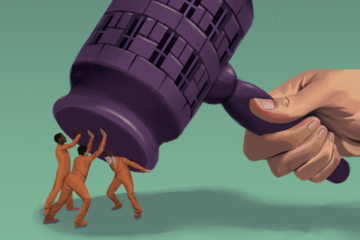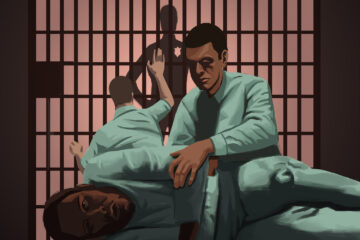


The American right wing faces a serious public relations problem, which is that their ideas, honestly presented, would largely fail to capture enough people’s enthusiasm to win elections. It’s a built-in downside when your philosophy elevates the interests of an elite few over the many; the many will not like it. So the only hope for continued movement in the conservative movement is to argue dishonestly, through fear and distraction, to incite panicked decisions instead of slow, thoughtful ones. Unfortunately for the right wing, our system is a deliberative democracy, and thus tends to bend towards the left with time.
In an effort to undermine a system that’s (rightfully) stacked against their interest, the pundits of the right have increasingly turned towards violent metaphors and language in an effort to short circuit people’s rational responses and entice them to vote against their own interests. Jeffrey Feldman analyzes some of the strategies in his new book Outright Barbarous: How the Violent Language of the Right Poisons American Democracy. In it, he details how everything from the right wing obsession with guns to the made-up “War on Christmas” are part of a larger right wing strategy to inject violence and fear into the national discourse, discouraging people from thoughtful discourse and inciting vote-by-panic.
Some of Feldman’s proposed solutions in the book are sure to ruffle the feathers of civil libertarians like myself, he freely admits that they are just suggested solutions. The book is mainly to start the discussion of the problem, a discussion that can, over time, lead to creative thinking about solutions that restore reason to our national discourse without bringing up the specter of censorship. And as a book that describes the problem, this is a remarkable and insightful one. I’ve read plenty on right wing framing, and I can safely say I’ve never seen the case laid out against the violent rhetoric of the right so concisely. It made me rethink my use of right wing frames like the “culture war”, and I suspect it will make most readers guiltily wonder if they’ve slipped into a habit of using violent metaphors to describe the peaceful if oft-times contentious process of political discourse.
Feldman writes the blog Frameshop and hosts daily discussions about language and framing in politics, with the ideas of George Lakoff as a stepping stone. With that in mind, I’d like to introduce Jeffrey in the comments, who will be answering questions about framing, his book, and the problem with violent metaphors.
Login Here
Share This
Spotlight
Hello and welcome everyone. Jeffrey will be here in a moment and we’ll be on hand to head up the discussion.
Jeffrey, Amanda, Welcome to the Lake.
Hello, FDLers! Thanks so much to Amanda for the fantastic kickoff to the discussion.
Looking forward to your questions and…Happy Mother’s Day!
Welcome to FDL Amanda and Jeffrey
Hope you are feeling OK now Amanda…
Jeffrey,
I have not read your book but was wondering how do we get the TradMed and such to call the right wing lies, LIES, without going into censoring?
Jeffrey and Amanda, happy that you could join us today!
Doing good.
Jeffrey, I can say that your book made me really nervous about metaphorical language I’d previously thought pretty harmless—describing this season as a “primary battle”, for instance. Am I overreacting, or is it imperative that we try to avoid even casual use of militaristic metaphors?
I still like naming missiles ‘peacekeepers’
As a pastor, I’ve long been disgusted with the violent rhetoric coming out of the TheoCon preachers. Does the book connect this religious rhetoric into the broader rightwing frame of “Be Afraid!”?
Welcome to the Lake. Just got your book a couple of days ago, so haven’t read it yet. A question though - haven’t we in this country for a long time used words of aggression to describe things? - War on drugs, war on terror, etc. We really seem to like to use the word war.
onward christian soliders….
it just goes on and on
On censorship: When the right cries ‘Censorship!’ we simply respond that only a flawed reading of the First Amendment could possibly assert that any and all form of expression is protected. Were that the case, nothing would stop my neighbor from standing outside my door and screaming at me all night long. So, first of all we have to know with confidence that we are not talking about censorship. The key is understanding that the courts have been engaged for decades in discussions of protections for writers/speaker and–in the case of broadcast media–for viewers/listeners. When I propose channeling pundits who use violent-rhetoric into late night time-slots and using ratings systems that are already widely in use–I am drawing on broadly recognized practices for protecting children from accidental exposure to certain kinds of broadcasting.
How terrific to have you hosting us, Amanda!
Welcome Mr. Feldman.
One thing Progressives need to admire is when we actually exhibit message discipline. We have a few examples of that right here at FDL.
But if we’re to combat the hateful, fear-mongering rhetoric that has invaded and sundered communications in this country, don’t we have a few lessons to learn from the Right about managing our own responses, if for no other use, to guide us in what NOT to do?
Again, welcome to you both.
Aren’t you somewhat afraid that the management of a labeling system would fall into the same partisan traps that other efforts have fallen into? I thought your idea of late-night shows/labeling was interesting, but I think bringing back equal time regulations would be more effective.
Tbogg today mentions how allegedly respectable right wing media outlets like the Washington Times are pushing vile framing against their targets such as the former Halliburton employees
Part of the point of the book is to get people to ask that very question: My goodness! I use these phrases and metaphors all the time–is it a problem?
In fact, casual use is not a problem. What becomes a threat to deliberative discussion is a programmatic use of violent rhetoric by key figures at the intersection of print, broadcast, and government. At that point, we begin to see a problem emerge.
But like Orwell, I also believe that the overuse of violent metaphors in political speech signifies a decline in ability to express ideas with language. So I am consciously trying to move people to broaden how they express themselves–and in so doing, strengthen the ability of political debate to achieve pragmatic goals.
It seems that what you are trying to do is the antithesis of the pithy, ad campaign sloganeering.
Unfortunately, way too many folks want the quick soundbite slogan rather than actually having to think about the words being used to express the idea(s)
Great question. Two chapters of OB connect up with religion–one on John Gibson’s ‘War on Christmas,’ and the other on Dobson’s violent nationalist parenting. In both cases, I connect to the bigger right-wing frame of liberals as physical threats to the future well-being of the country. In Dobson’s case, in particular, I focus on the bizarre fear that if parents do not regularly beat our children when they are young, then they will become amoral citizens that build a society full of sexual debauchery and violence. Dobson’s world is the most saturated with fear and violence of all the pundits I examined.
Somebody gave me a Dobson book when I had my first child, I was horrified by it’s parenting suggestions. I’m glad to see him being challenged as the sadist he is…
We do like the word ‘war,’ to describe social programs–or, rather, groups of government programs. The more it gets overused, however, the less it becomes a frame that brings people into a common set of goals and the more it simply becomes a tactic for stigmatizing.
Jeffrey, so great to have you at FDL. And thanks so much for writing such a thought-provoking read. You give a LOT to think about in it, and to contemplate as we cover the insanity around us.
Amanda, thanks so much for the great introduction - always great to have you!
(Am on hold with Sam Seder’s Show at the moment, but am following along…)
Welcome to the Lake, Jeffrey.
I’m waiting anxiously for my copy of your book because it explores a subject I’ve discussed frequently at my blog Orcinus. I’ve been writing about it mostly from a ground-level sort of experience — talking about the way this kind of rhetoric pollutes so much of our political discourse, both at the very local and personal level all the way up to the elite punditry.
A lot of conservatives (notably Michelle Malkin) like to complain that it’s the left whose rhetoric has been, in her phrase, “unhinged.” But as I’ve explored, there’s a real distinctive quality to right-wing rhetoric that I’ve teased out and discussed at some length: eliminationism, or the expression of the desire to eliminate the opposition rather than engage them. Moreover, the sheer volume and intensity of this rhetoric far outpaces anything we’re seeing from the left.
I’m wondering how you respond to the right-wing retort that “liberals are just as bad.”
To the extent that progressives and liberals become aware of (1) the rise of violent language on the right and (2) the damage violent right wing language can cause to the civil conversation that fuels our democracy–if we take those two points into account widely, then we can still move forward even with the general weaknesses we may see in message discipline.
In general, though, right-wing messaging will always be more disciplined because conservatives have a very different relationship to the idea of speaking with a unified voice. They generally see it as a sign of strength, whereas progressives view it as a sign of weakness.
How do you see Rush Limbaugh’s recent chaos campaign? We still don’t appear to be making inroads to turning these voices down …
At my place, a conservative troll challenged the idea that right wingers have a special affection for the violence and fear that the gun control debate can generate, and suggested it was a somber concern for constitutional rights that drives anti-gun control forces. We pointed out that if this were true, the same people would be at the front of the line screaming about the loss of every OTHER right that the Bush administration is laying waste to, but instead we get crickets.
There’s been cognitive research that shows that the more people are exposed to the fear of death, the more conservative they get. It’s like right wingers just instinctually knew what to do.
The “War on Drugs.” Availability has seen no measurable decrease, DEA and local police forces involved in corruption, exploding prison population, etc. People see it as a joke, used now to enrich private prison companies and increase funding for local police departments. Linchpin of the “tough on crime” meme.
Thanks for the question, David. And thanks for all your work on this topic.
The first key to responding to ‘the left who’s causing the trouble’ argument is to see that we in fact do want to bring them onto this terrain. We want a discussion about violent rhetoric because it allows us to shine a light on this huge problem. Malkin and the like are at best responding and responding weakly by teasing out comments from blogs and then making guilt-by-association arguments.
But beyond that, a crucial point I make in the book is that 40 years ago, the problem of violence in politics was found on both the left and the right (H. Arendt’s point), but that today the problem is almost entirely on the right–and with these pundits–and in these books–and on these shows.
It’s been said many times that it’s in their DNA.
This is part of why Altemeyer’s work on authoritarianism is both so useful and so important.
Dobson is a dangerous voice on the TheoCon right, because of his focus on gender roles, familial relationships, etc. Beyond the discussion of corporal punishment, his relational language is all about power and control. On this Mother’s Day, I’ll give you three guesses as to where those two reside.
But beyond Dobson - a radio shrink, not an ordained minister — the pulpit rhetoric of folks like Hagee, Robertson, the late Jerry Falwell, and hundreds of lesser-known preachers is at least as destructive. It creates a martyr’s complex, with a dash of religious paranoia on top.
It’s very bizarre to hear “Be afraid — be very afraid!” from these preachers, while the Bible from which they preach tells story after story of God’s angelic messengers proclaiming some version of “Do not be afraid!”
Thanks, Jeffrey. FWIW, I’m at work on a manuscript on this subject as well. I should be unhappy for selfish reasons, I suppose, that you’ve kind of beaten me to the punch with your book, but (a) we actually have different approaches and slightly different points to make (I raise the issue of fascism, based on my work with actual fascists) and (b) it’s so important that I’m actually just delighted to see the subject being discussed in a serious way.
Thanks for that link. That looks like a great read.
On ‘Operation Chaos’: I wrote a piece comparing Limbaugh’s broadcast transcripts on Operation Chaos to Rwandan hate radio from the 1990s, concluding that they had some key differences, but some disturbing similarities. It percolated up through the Internets and Rush responded to it on air Wed.
The reality, I believe, is that none of these folks have been called out for precisely what they are doing: broadcasting to the American public that liberals are allied with terrorists, harbor murderous intent, have committed crimes punishable by death, should be fought as if they are an enemy, etc., etc. To simply name these pundits ‘violent,’ show the precise language they are using and where, and then to put that out in a public forum–that forces them to deal with a reality that is widely viewed as socially unacceptable.
Anyone who rightfully complains of injustice is curse by the Right as a “Victim.” To them that’s the lowest of all categories, worthy of nothing but dismissive contempt.
Hope you enjoy. You may already be familiar with precepts; John Dean leaned heavily on Altemeyer for his book Conservatives Without Conscience.
Dobson and company are particularly scary people, because they do more than use a handful of metaphors for nakedly partisan ends. They advocate an entire authoritarian worldview that is hard to escape once you’re entangled in it.
Indeed. What was so frightening about writing the chapter about Dobson was the realization that I could–if I just let myself go a bit–fall deep into believing everything he says. There is both a long-term completeness and an immediate gratification that comes with Dobson’s world of whipping children with switches and ridding the world of homosexuals.
Dakine01 raised the question of censorship above, and you spoke of a ratings system. Another alternative approach is that of putting pressure on advertisers and sponsors, as Spocko did successfully with Melanie Morgan in the San Francisco area.
What’s you view on the viability of pressuring sponsors to drop their support for those with violent rhetoric?
Incidentally, Amanda, another excellent study along these lines is Robert Jay Lifton’s Superpower Syndrome [excerpt here] which examines from a psychiatric perspective the sort of psychic trauma inflicted on the nation by 9/11 and how it created a propensity to “splitting” and a resultant increasing in dualism as a worldview — and how the Bush administration seemed to push every button in view to actually worsen this problem.
I still can’t believe Coulter’s making the rounds after her ‘lynching’ comment …
And in certain parts of the country, Dobson’s voice so pervasive that “escape” is not really an option. You can push back against it in your own life, but it’s still there in the community and still poisoning the climate.
I actually thought the Tim McVeigh/New York Times comment should have made her a permanent persona non grata, but I misunderestimated the right-wing appetite for such talk and the media’s increasing tolerance of it.
Great discussion … thanks for being here, Jeffrey, and thanks for hosting, Amanda and FDL.
One thing I was wondering is what you think of Marta Stout’s The Paranoia Switch, which discusses people’s reaction to fear-based rhetoric.
Also, some areas of the progressive blogosphere consistently use some very pugnacious language, with a lot of “war” and “battle” metaphors. I certainly don’t think it’s part of the same kind of strategy to increase tension and fear; on the other hand, do you see this as in some ways having some similar effects?
Pressuring sponsors can be tricky. I take it on a case by case basis. In the end, what I would like to see is a shift in journalistic practice–the emergence of the idea that violent rhetoric is a widespread problem, and that responsible producers should seek to either minimize it or track it into entertainment venues where viewers can have better resources for making informed choices.
Coulter’s all purpose response when someone calls her on her hateful rhetoric is to claim that she was “joking” and that whomever is complaining should “lighten up.”
Hi Jeffrey! Having connectivity issues but as long as I have this right now, wanted to share:
Frameshop group at Facebook:
http://www.facebook.com/group.php?gid=2396256756
This is one of my most often argued topics in the various networks and I really appreciate your work here. What I’ve read so far is inspiring. Thanks!
Nothing is suprising any more … look at the misogynist racisit hatespeech spewed by Imus, and he’s backkkkkk.
Nothing would encourage that “shift in journalistic practice” faster, I think, than a little encouragement from the bean counters to the producers, to prod them in the direction of greater responsibility: “Sorry, I can’t sell the ads on that show as it currently runs. Either change the rhetoric or change the timeslot.”
From what I’ve read of Stout, I think it’s a very important discussion. The idea that our brains have been ‘rewired’ as a result of 9/11–both as a traumatic event and as a political moment–is very powerful. I think many people have an ‘ah, ha!’ moment when they read books describing how representations in the media (images, language, etc.) physically alter our bodies and, as a result, our sense of security.
These tactics are shockingly effective at degrading people’s relations on an interpersonal level in a short amount of time. In March, I saw a presentation about race relations in Houston at the Texas ACLU conference, and the statistics were shocking—over the past few decades, all the various racial groups reported increasingly pleasant attitudes about dealing with members of other races, up until 2005, when the nasty rhetoric of the immigration debate and of the post-Katrina race-baiting to get BushCo off the hook created a nosedive.
The “War on Christmas” has the same effect, putting an unnecessary chill between Christians and non-Christians in their interpersonal relations. Is there a way to express this damage convincingly to the public so that people start to actually fight back against the way right wing pundits hurt the peace? I remember when Clinton tried to link right wing pundits (rightfully) to the OKC bombing, and all he got was blowback. People don’t want to think that they’re influenced the way that they are.
Is there a way to address and confront the right-wing propaganda and side-step the inherant dualism? The whole right/left, conservative/liberal, violent/non-violent opposition based mind frame. To my mind liberalism is an intergral part of conservative ideology.
I disagree with your premise.
respectfully
no problem, i’m frequently wrong … but why keep bringing these folks back when they keep inviting slander and libel suits? Don’t they all shout fire in crowded rooms? Aren’t there supposed to be laws against that even within the bounds of free speech?
Hi Jeffery!
I think you are basically correct on this point but….
There an be now doubt by anyone who’s spent time in dKos, OpenLeft or TPM threads, MyDD also although Jerome is pretty good about banning advocates of violence, that many poseurs on the progressive left are happy to use the exact same rhetoric and imagery as the most bloodthirsty of the ReichWing.
Indead, Keith Olbermann recently described what many are characterizing as murder to get Hillary out of the primary contest.
What are your thoughts on this variant on the ‘Stockhome Syndrome’?
Agreed, although I think it still remains difficult for people to see how their own words contribute to this as well as the media.
What do you think of the idea of voluntary speech codes for various sites/media entities? This could be either a complement for or alternative to ratings. It’s easiest to think of in the blogosphere: “violent metaphor-free sites”, “hate speech-free zones” (where hate speech in comments is deleted and offenders warned and then banned), and so on.
Amanda, do you have any links to those statistics?
Good question. I bring in the concept ‘deliberative democracy’ as a way of reframing the entire discussion. The goal is not to eliminate right or left, but to have a certain kind of debate in which all views contribute. It’s a concept I draw in from theories of government and critical thought, but also–not shy about admitting this–from a certain nostalgia for the debates about the Constitution. Two books gave me this idea. The first was Arendt On Revolution, in which she discussed the Framer’s obsession with creating a republic that would not just be strong, but would endure. The second was Rorty’s Achieving Our Country, in which he puts forth a nostalgia for American pragmatism.
Personally: Even before raising the question of speech codes, I think a small dose of this discussion would go a long way on most blogs. It’s really Orwell’s point about the impoverished nature of political speech that will likely capture people’s attention. Can we possibly be saying what we want to say–what we mean–if we allow ourselves to get drawn in the violent rhetoric rut? Most bloggers would answer that we cannot and relish the challenge of moving the discussion to more effective speech.
One way to insure that such individuals are not merely espousing views for the ratings would be to take the money aspect out of it entirely. Separate “free speech” from “paid speech”. I’ve heard from many people that Limbaugh doesn’t believe half of what he says…but that he’s simply a greedy SOB willing to drag down civil discourse and debate (and the country itself, if necessary) to fill his wallet and ego.
So make these sorts of programs “unsponsored” and only part of a TV or radio stations “Public Service” fulfillment. Mr. Limbaugh may have the right to elucidate his views, but he doesn’t have the right to use the public airwaves to get rich. And if Limbaugh could not get sponsors then there would be little reason to having him on vs. any number of other voices espousing many different views.
Yep. This Powerpoint, slide #24, figure #18.
Good point but currently such speech is not deemed the danger to the social fabric it truly represents. All society’s rely on a level of trust between the members of same. When that trust is damaged too deeply the society itself can decline or even fail. See Collapse by Jared Diamond or my post: My Theory of Pie to see that modern sociologists and economists now recognize that bad things can be the result of the divisive speech Jeffry is analyzing in his book.
As we learn more we might very well see legislation banning fallacious statements which undermine societal trust.
Thanks!
Bullseye.
And Americans are figuring out that they can’t afford to pay for that massive prison population fueled by “non-violent” offenders.
Jeffrey, Amanda, Welcome to the Lake.
I totally agree. Many are familiar with “The Federalist Papers” but fewer are aware of “The Anti-Federalist Papers and the Constitutional Convention Debates.” A boon for anyone wishing to study the Constitution and a must for the real junkie.
I disagree. Being a writer/pundit is work, and people should be paid for their work. I’m not sure how you’d get around the basic labor issues if you suddenly mark off a certain kind of writing or speaking as ineligible for compensation. The result would not be a cleaned up discourse, but one that got sillier, as talented people would have to take paid work talking about legally allowed topics like sports or entertainment.
Will everybody plese stop metioning George Orwell!!!!!!
Loathesome disgusting creature.
A bill is coming up in CA, where the state is locked in a structural deficit by ReThugs refusal to consider ANY new taxes, which calls for the further expenditure of hundreds of billions to build more prisons. This will be a bellweather for the citizenry’s understanding of what is really going on with the ReThug regressive taxation policies.
Great reply, thanks!
The authoritarian mindset exists in all of us, and several persuasive cases have been made that it’s a case of stunted emotional development. Because it’s a subset of everyone’s personality, it looks eerily similar everywhere and everyone can potentially get sucked in.
BTW Limabugh is already blowing loud and hard about his great influence on the campaign and cites the MSM as proving that his efforts worked. And laughably He’s Now For McCain and threatening to bring Republican’s back to McCain this Fall. Expect him to whip out every racist and right-wing fear trick in his (non-prescription doctor) bag of tricks.
Christopher Hitchens is right up there with Coulter and Malkin — adding drunkenness to hatefulness. He’s a Troskyite cliche.
Could you provide a link, I must have missed that Olbermann segment.
Jeffrey, every time I see the topic of framing come up, I see people revolt against the idea that the metaphors we use influence our feelings on the subject. Is there some kind of evidence supporters of the theory (like myself) can point to on that topic?
I couldn’t agree more … and also see it as tying back to deliberative democracy.
Mike Godwin talks in I seem to be a verb about his introduction of Godwin’s Law as a memetic experiment to try to counter one very specific form of overblown rhetoric. He certainly succeeded in establishing it as a meme. While it probably hasn’t cut down on Nazi analogies, it certainly makes everybody aware of the issue; in the right situations simply bringing it up can be an effective way of pointing this out. It would be useful if there were some similar conventions for flagging violent rhetoric in online discussions — at the very least it could help raise consciousness about how much of this goes on.
This is from Rachel Sklar at HuffPost on the Olberman comment.
I’ll let my friend Anglachel introduce you to it. And for the others here she, the she part is very important here, has quite a few links in this post to examples of what I am talking about.
FWIW, I hang out some on a sports blog, a pay-site, where ethnicity comes up routinely. As much as some of us have fought successfully against the most obvious stereotypes, commenters quickly hone in on ways to do obvious character assassination without resorting to them. It’s “code” and everyone on both sides knows what they mean.
I like your goal, just not sure how we get there.
Welcome, Jeffrey and thank you, Amanda.
Jeffrey, you’re nothing if not prolific!
Why should Limbaugh be paid more for the same work done by someone else? Why should a volunteer for a campaign get paid nothing when someone else gets paid tens of thousands.
This whole thing about “political speech” being work seems to ignore that it conveys ideas that the “speaker” presumably WANTS to expose the society to…and it is being done on the publicly owned airwaves. In essence he is being paid to EXCLUDE other views on our airwaves by individuals that choose to “buy” those airwaves in whom we have entrusted with them.
I’m sure writers love to get paid…but most of them aren’t taking the public commons in order to obtain that money. Would a band promoter be allowed to set up rock concerts in a public park, charge admission, and monopolize the facility excluding it’s usage by others? That’s essentially what these networks are doing FOR Limbaugh and themselves.
Olbermann’s comment (I think he suggested that someone should take Clinton into a room and off her) was wrong, and I am glad he was called out on it by Rachel Sklar at HuffPo. But keep in mind, that this was not a pattern by KO, but just an incident. I think in a decent society, citizens remind each other when accepted standards have been breached, why it’s a problem, and then we get back to business. That’s what happened there–evidence of things working well.
In the case of the kossacks etc. who may throw out this language: I distinguish between people with access to big broadcast media and citizens expressing themselves. People get drawn up into a moment rife with violent rhetoric–but those individuals do not have the broadcast reach to drive the system. Big media pundits do have that reach.
I also prefer to push back against voices that have left a long trail of examples, the better to show a pattern.
Another book to add to my summer reading list!
Well you got me.
I don’t know if we want to get into the idea that someone’s work shouldn’t be paid because someone else lays protest on it. God knows I’ve had enough people try to take the knees off my ability to make rent. In our system, you have a right to make a lot of money if someone’ll pay you a lot of money for what you do. Now, I don’t think it’s fair to make artist/pundit-only exceptions to that rule.
Just remember: A system that took away Limbaugh’s salary would force Olbermann to go from being a commentator back to being a full-time sportscaster.
Hello, from Grayson KY. It seems like the language from the right suffers from the same pitfalls as drug abuse and pr0n. It must take more and more extreme forms to get the target audience off.
Yet MSM continually treat these increasingly radical pundits as “very serious people”.
Another example for the need of a blogger ethics panel.
Do you cite any stats in your book on this escalation, or is it just my imagination.
I do realize it seems unfair that Limbaugh makes more money than Jane Hamsher. ;) But it’s also unfair that Carrie Underwood makes more money than Carrie Brownstein.
Bullseye.
I’m supporting the Democratic nominee for President.
I don’t want to any way diminish the misogyny that is part and parcel of our culture. I do want to point out that within the Democratic party, Biden started the latest round of ethnic awakening. Obama is so “clean and articulate.” When Biden skated on that, Lieberman pushed it further with: “are you a Bill Clinton Democrat or a Jesse Jackson Democrat.
I show people that metaphors are everywhere and we use them without thinking. My favorite example is the family ‘tree.’ I ask people to describe their extended family without using any words having to do with trees. It can be pretty funny. Then I ask them to describe our policy towards terrorism without using any language having to do with ‘war.’ In those examples, people see that some metaphors help us think clearly, while others cloud our ability think at all.
But I’d be lying if I didn’t admit that it’s a hard case to make with a skeptic…
Well, I’m not sure how we get there either — but I do think there are ways to make progress. Something that would be very helpful is enclaves in the blogosphere and social networks where we could engage in deliberative discourse without having it constantly disrupted. I also think that good educational resources and discussion threads are helpful; it helps people recognize the codes and call others’ attentions to it. [Generalizing the approach taken Clinton Attacks Obama wiki could a very effective mechanism for this.] Also more mundanely, there are ways in which better technology would help — Slashdot-style community moderation with reputation, for example.
Of course, these all require a fair amount of effort, and thus far nobody’s prioritized them.
LOL - lots more to come!
FWIW, I think FDL does strive to be one of those places where intelligent discussion can take place without degenerating into personal insults.
There is a lot of attacking of arguments but no where near the amount of attacking the commenter that is tolerated at other sites.
Just purchased your book via the FDL link.