torturewrong-2.jpg

Second in a series

The other day, Emptywheel invited her readers to play a little game with the Yoo torture memo.  She invited them to try to find a mention of a Supreme Court case called Youngstown Steel. You won’t find it mentioned in Yoo’s memo.

So, you may be asking, I’m sure there are lots and lots of Supreme Court cases not included in the memo, what’s the big deal? The big deal is that Youngstown Steel is the case which defines the limits of presidential power in a time of war. Yes, there are other cases which deal with this issue, but Youngstown v. Sawyer, 343, U.S. 579 (1952), is the case where the Supreme Court set forth a series of balancing tests for determining how much power a president can assert during wartime, relative to pre-existing treaties, statutes and the Constitution.

To avert a nation-wide strike of steel workers in April 1952, which he believed would jeopardize national defense, the President issued an Executive Order directing the Secretary of Commerce to seize and operate most of the steel mills. The Order was not based upon any specific statutory authority but was based generally upon all powers vested in the president by the Constitution and laws of the United States and as President of the United States and Commander in Chief of the Armed Forces.

The Supreme Court then analyzed whether the president may do whatever he believes to be necessary to protect the nation in a time of war based on his Commander in Chief powers. John Yoo says that based on the power as Commander in Chief, the President can do ANYTHING, even ignore Treaties and Acts of Congress, if he believes it necessary in order to protect the country. Even crush the testicles of the child of a detainee being interrogated.

Youngstown is still good law, it hasn’t been overturned, yet Yoo somehow managed to ignore it. Gee, I wonder why?

Maybe because of a quote like this?

The President’s power, if any, to issue the order must stem either from an act of Congress or from the Constitution itself.

Or this?

In the framework of our Constitution, the President’s power to see that the laws are faithfully executed refutes the idea that he is to be a lawmaker. The Constitution limits his functions in the lawmaking process to the recommending of laws he thinks wise and the vetoing of laws he thinks bad. And the Constitution is neither silent nor equivocal about who shall make laws which the President is to execute. The [343 U.S. 579, 588] first section of the first article says that "All legislative Powers herein granted shall be vested in a Congress of the United States . . . ." After granting many powers to the Congress, Article I goes on to provide that Congress may "make all Laws which shall be necessary and proper for carrying into Execution the foregoing Powers, and all other Powers vested by this Constitution in the Government of the United States, or in any Department or Officer thereof."

Or this?

The President’s order does not direct that a congressional policy be executed in a manner prescribed by Congress – it directs that a presidential policy be executed in a manner prescribed by the President

Or this?

The Founders of this Nation entrusted the lawmaking power to the Congress alone in both good and bad times. It would do no good to recall the historical events, the fears of power and the hopes for freedom that lay behind their choice. Such a review would but confirm our holding that this seizure order cannot stand.

By now, even without a law degree, you have figured out that SCOTUS overturned the President’s action.

Some of the most prescient and eloquent prose in this case comes from the concurring opinion written by Justice Frankfurter. These words could have just as easily been written today.

To that end they rested the structure of our central government on the system of checks and balances. For them the doctrine of separation of powers was not mere theory; it was a felt necessity. Not so long ago it was fashionable to find our system of checks and balances obstructive to effective government. It was easy to ridicule that system as outmoded – too easy. The experience through which the world has passed in our own day has made vivid the realization that the Framers of our Constitution were not inexperienced doctrinaires. These long-headed statesmen had no illusion that our people enjoyed biological or psychological or sociological immunities from the hazards of concentrated power. It is absurd to see a dictator in a representative product of the sturdy democratic traditions of the Mississippi Valley. [343 U.S. 579, 594] The accretion of dangerous power does not come in a day. It does come, however slowly, from the generative force of unchecked disregard of the restrictions that fence in even the most disinterested assertion of authority.

However it is in Justice Jackson’s concurrence that we find the famous balancing test. Yes, the same Justice Jackson who was the prosecutor at the Nuremberg trials and who gave the famous speech about not politicizing the prosecution function. Here’s the test, it’s pretty straightforward and see if you think it essentially guts Yoo’s whole argument.

1. When the President acts pursuant to an express or implied authorization of Congress, his authority is at its maximum, for it includes all that he possesses in his own right plus all that Congress can delegate. [2] In these circumstances, [343 U.S. 579, 636] and in these only, may he be said (for what it may be worth) to personify the federal sovereignty. If his act is held unconstitutional under these circumstances, it usually means that the Federal Government [343 U.S. 579, 637] as an undivided whole lacks power. A seizure executed by the President pursuant to an Act of Congress would be supported by the strongest of presumptions and the widest latitude of judicial interpretation, and the burden of persuasion would rest heavily upon any who might attack it.

2. When the President acts in absence of either a congressional grant or denial of authority, he can only rely upon his own independent powers, but there is a zone of twilight in which he and Congress may have concurrent authority, or in which its distribution is uncertain. Therefore, congressional inertia, indifference or quiescence may sometimes, at least as a practical matter, enable, if not invite, measures on independent presidential responsibility. In this area, any actual test of power is likely to depend on the imperatives of events and contemporary imponderables rather than on abstract theories of law. [3]

3. When the President takes measures incompatible with the expressed or implied will of Congress, his power is at its lowest ebb, for then he can rely only upon his own constitutional powers minus any constitutional powers of Congress over the matter. Courts can sustain exclusive presidential control in such a case only by disabling [343 U.S. 579, 638] the Congress from acting upon the subject. [4] Presidential claim to a power at once so conclusive and preclusive must be scrutinized with caution, for what is at stake is the equilibrium established by our constitutional system.

Did you see anything there that said the President could just ignore treaties or statutes passed by Congress? Like the War Crimes Act for instance?

Nah, me neither. Probably why Yoo decided not to mention it. It might get in the way of crushing children’s testicles.

He makes me so ashamed to be a lawyer.

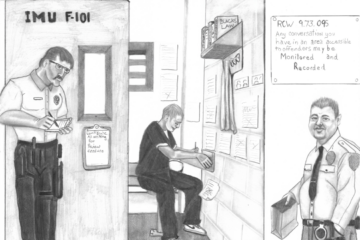
[Editor's note: The photo atop the post, by takomabibelot, features a banner created and designed by Firedoglake reader BonnieT of Austin, Texas, where she operates OpposeTorture.org.]

Related posts:

  1. China Halts Steel Factory Sale After Manager is Beaten To Death
  2. How to Leave Guantanamo in 10 Days
  3. Do We Expect Too Much From The President?
  4. OLC: Presidential Power at Root of GOP Opposition to Dawn Johnsen
  5. July 4th and a Health Care Plan with a Public Option